
Learning Systems
Worked Examples: Gradually Move to Independent Problem Solving
Use complete and incomplete examples as a verifiable bridge to independent problem solving.

A worked example presents both a problem and a route to its solution. It is useful when a procedure is new or complex enough that unguided problem solving would consume attention needed for learning. Yet a completed procedure is not the goal. If support never changes, a learner may follow someone else’s steps without being able to select and execute them independently.
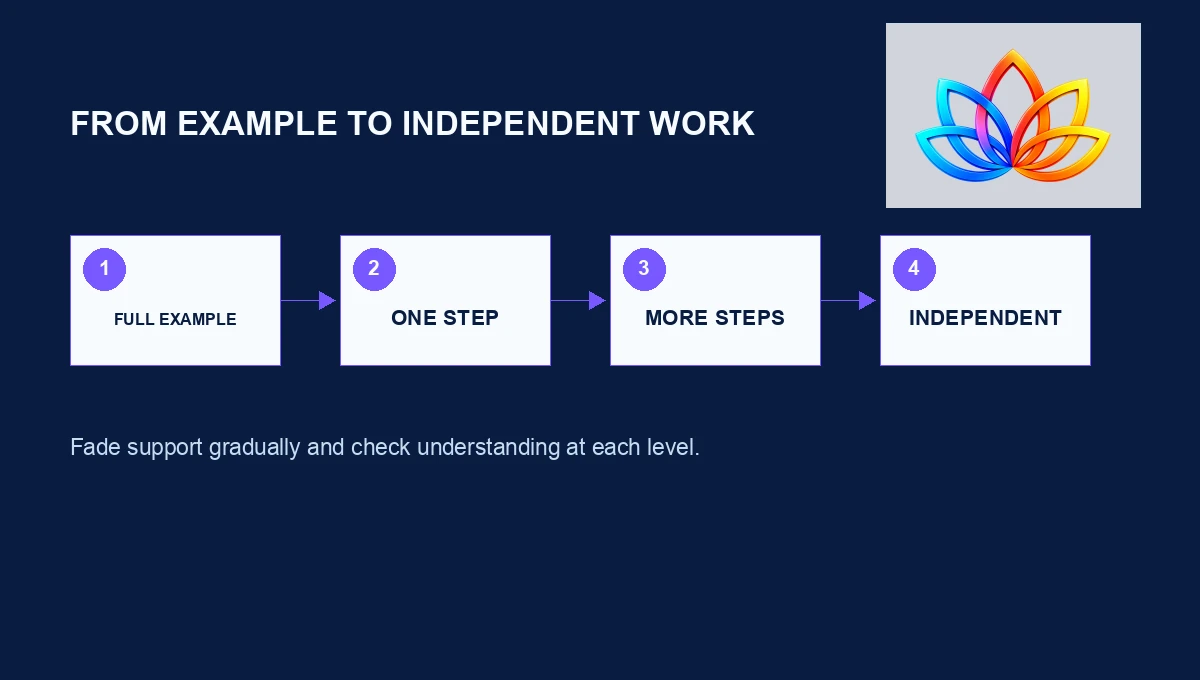
A practical bridge is to fade support: study a complete example, complete one missing step, complete several missing steps, and finally solve a problem independently. The NSW Centre for Education Statistics and Evaluation recommends worked examples for new content and gradually increasing independent problem solving as proficiency grows. Research by Renkl, Atkinson and Große examines stepwise fading as a transition from examples to independent work.
1. Check whether a worked example is the right starting point
Start with the intended independent action: what decision, principle or procedure must the learner apply without help? A worked example is most useful before a stable schema exists. If similar problems are already solved reliably, extensive guidance may be redundant and slow performance.
Match the later task at the level of principle, not necessarily surface detail. Mark critical steps, reasons and the result check. Remove decorative or secondary information that competes for attention.
| Phase | What remains visible | Learner action |
|---|---|---|
| Complete example | All steps and explanations | Connects each step to the principle |
| One missing step | Most of the procedure | Completes and explains one step |
| Several missing steps | Structure and key cues | Plans most of the procedure |
| Independent problem | Problem and success criterion | Selects and checks the whole procedure |
2. Break the complete example into explainable decisions
Do not ask the learner merely to read the solution. After each critical step, ask what the step is trying to achieve, which rule supports it and how the result can be checked. The response may be spoken or brief, but it must refer to the actual move.
Include at least one contrast: a similar problem where the same step would be wrong or unnecessary. This discourages copying a sequence without its conditions. When text and a diagram are both used, make their relationship explicit rather than adding parallel detail.
3. Remove one meaningful step and require a reason
The first incomplete example should not be an endurance test. Remove a step that reveals understanding while leaving useful context before and after it. The learner supplies the step, states a reason and checks whether the later procedure remains consistent with that choice.
If the answer is wrong, feedback should identify the principle or constraint, not merely expose the missing entry. Then offer a related example with the same kind of omission. One successful response is not sufficient evidence for removing all guidance.
4. Increase omissions in response to observed performance
Next, remove several steps or earlier planning steps, where the direction is less obvious. Do not increase difficulty only because the next lesson was scheduled. Inspect accuracy, explanation quality, cue dependence and the learner’s ability to detect an error.
The pace varies by learner and task. If errors cluster around one principle, restore support only there. If the learner solves and explains reliably, use a less similar example. In both directions, changing support should respond to evidence, not function as a reward or penalty.
5. Avoid passive copying and premature withdrawal
A common error is to confuse following with learning: every displayed step may make sense, yet the learner cannot choose the first step alone. Another is an abrupt jump from a complete example to a complex independent problem. The resulting failure does not isolate which part of the transition is missing.
Keeping detailed support for too long also creates difficulty. As expertise grows, explanations that were helpful can become redundant. Periodically remove a cue and check whether the learner still selects an appropriate method rather than filling a familiar pattern.
6. Run a four-problem cycle and preserve evidence
Prepare four problems based on one principle with different surface details. The first is fully worked; the second omits one critical step; the third omits several; the fourth is independent. Before starting, define evidence: accurate result, justified choices and an effective check.
After each problem, record cues used, errors and the learner’s explanation. If the third problem fails, restore targeted help rather than replaying the entire complete example. If the fourth succeeds, test another context after a delay. The aim is transfer of a principle, not memory for one layout.
- Define the principle and evidence of independent success.
- Present one clean, complete, explained example.
- Remove one critical step and ask for the reason.
- Remove more steps only after the previous level succeeds.
- Set an independent problem with changed details.
- Record performance and adjust the amount of support.
7. Frequently asked questions
Should every topic begin with a complete example?
No. It is especially useful for a new or complex procedure; for a well-practised skill it may be redundant.
Which step should disappear first?
Choose a meaningful step that reveals application of the principle while leaving enough context to avoid guessing.
How many examples are enough?
There is no universal number. Base the transition on accuracy, explanation and successful checking across more than one problem.
What if the learner only copies?
Require a reason for each critical step and use a contrast where the same move would be inappropriate.
Should support only decrease?
No. Restore targeted guidance when evidence reveals a specific gap, then fade it again after success.
Must the independent problem be entirely different?
It should preserve the principle while changing surface details, so it tests transfer rather than memory for the displayed sequence.
8. Conclusion
A worked example is temporary scaffolding, not the finished learning product. Turn the procedure into decisions, fade help gradually, require reasons and adjust the pace to actual performance. When the learner can select, execute and check the method in a new problem, the example has done its job.
Sources: NSW CESE: Cognitive load theory in practice, Renkl, Atkinson i Große: How Fading Worked Solution Steps Works, Sweller, van Merriënboer i Paas: Cognitive Architecture and Instructional Design. Accessed 20 November 2026.
Continue with a guide to defining verifiable success criteria.
About Meta Life Vision
Meta Life Vision is an educational brand within Yevt Group. YEVT DIGITAL works on the Meta Life Vision website and provides website development and other digital solutions.