
Learning Systems
How to Ask for Useful Feedback on a Draft
Ask one question that will help you revise your draft.
When you send someone a draft and ask what they think, you also leave them to decide what to review. They may fix a comma and skip the section you want help with. If your next revision will focus on the introduction, ask what they understand from it and where they need more detail.
Give the reader one clear task
Compare “Is this any good?” with “What would you do first after reading section two?” The first invites a general impression. The second gives you an answer you can compare with your intention. In experiments on online peer review, changes to how a review task was presented affected the comments people gave [1]. This is a reason to pay attention to your instructions. It does not guarantee that one question will work equally well in every setting.
Set up the review before sharing the draft
Choose a section you can still change. Describe the intended reader and what they should understand in one sentence. Ask for one action and have the reader point to the sentence that led to their answer. Let them respond before you explain the passage out loud. If you supply the meaning in advance, it becomes harder to tell how well the draft guided them.
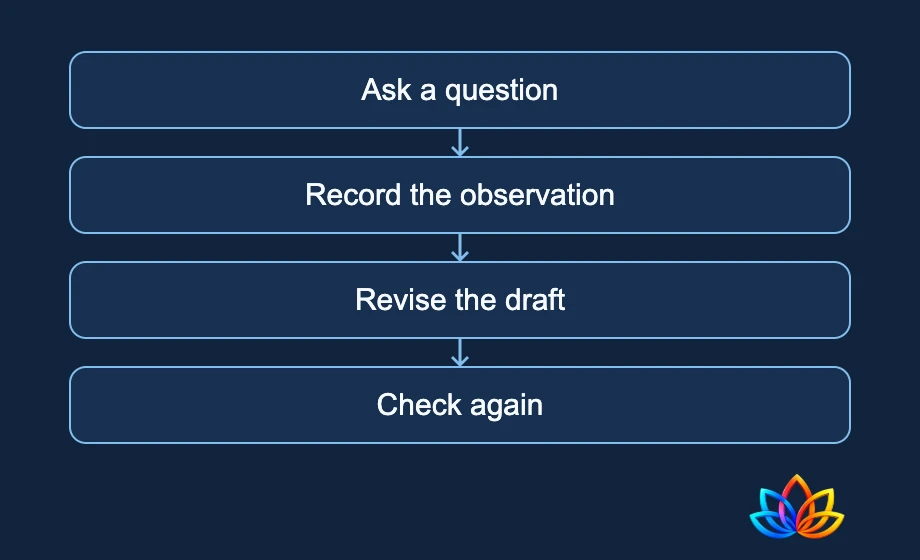
- Ask a question
- Record the observation
- Revise the draft
- Check again
Adapt the question to the draft
For a lesson, ask which assumption is missing between two steps. For a work instruction, ask readers to say what they would do first and what they would check before continuing. For a project proposal, ask what decision the text calls for and what information they need to make it. Keep the same criterion when you review your revision.
An illustrative example from a procedure
Your draft says, “Collect the documents and send the request.” The reader says they would send a message straight away because they do not know which document is required. Record the observation and the passage it refers to. Then separate the actions, name the required document and verify its name. Give a fresh reader the same task. If they can tell you what to collect before sending, you have concrete evidence that this instruction is clearer to that reader.
Check what the comment actually shows
The observation “I didn't know what came next” and the suggestion “put this in a table” play different roles. The observation describes one person's reading. The suggestion offers one possible change. Cho and MacArthur studied how types of comments related to revisions in student writing [2]. Check proposed changes against the purpose of your draft and its sources, especially if a change would alter a factual claim.
Before sharing, add a short brief: “This is a working instruction for a colleague doing the task for the first time. I am checking the order of actions, not the document's appearance. Please describe what you would do first and point to the sentence that led you there.” This sets the scope while leaving the reader free to show what the draft communicates.
Keep three separate fields in your notes: the passage, the reader's observation, and your revision decision. Identify a heading or sentence in the first field. Record the answer without repairing its meaning in the second. Only then decide whether to revise, verify a fact, or request clarification. This is a proposed working method, not a standardized quality measurement instrument.
| General comment | Clarifying question |
|---|---|
| The introduction is unclear. | Who does the introduction seem to be written for? |
| A detail is missing. | What information do you need to take the next step? |
| Put this in a table. | Which two pieces of information do you want to compare? |
If someone suggests a table, first ask what problem it would solve. The missing element may be the name of a document rather than its layout. Adding columns could simply move the same ambiguity elsewhere. If the reader needs to compare the same information across several options, however, a table is a candidate revision to test with another reading.
Retain comments you decide not to use. Add a brief reason: the comment assumes another audience, needs a source check, or does not address the observed obstacle. You can then reconsider your decision without searching through the entire conversation. Avoid treating one reader's response as evidence about every future reader.
Choose a draft you are allowed to share for this exercise. Remove personal information, business secrets and other people's confidential attachments. To check a sequence, you can often create an invented example with the same steps. Where specialist judgment is needed, separate clarity from accuracy: a reader can understand an instruction that is factually wrong.
Try the method on one paragraph
Save the first version. Share a paragraph with this request: “Underline the words that tell you what to do. Describe that step in your own words.” Compare the reply with the intended action. Change the part that caused the problem and ask the same question again. If two readers disagree, ask each to point to the words that led them to their conclusion.
Frequently asked questions
Who should review my draft?
Choose someone whose knowledge of the subject is close to that of your intended reader.
Should I ask for a score?
If you need help revising, first ask for a specific observation.
What if the reader just says it is good?
Ask what they understood and which part of the text told them that.
Should I follow every suggestion?
Check whether it addresses the observed problem and preserves accuracy.
Who should check the revision?
When possible, ask someone who has not seen your previous explanation.
When is an expert review useful?
Ask a specialist when interpreting or correcting the comment requires subject expertise.
Conclusion
Choose one reading goal, ask a question that calls for a concrete answer, and keep a record of what you changed. Give the same task in the next round to see whether the target passage is clearer to the reader.
Set a success criterion before the next review
Sources
About Meta Life Vision
Meta Life Vision is an educational brand within Yevt Group. YEVT DIGITAL works on the Meta Life Vision website and provides website development and other digital solutions.