
Learning Systems
Success Criteria Before You Start: Define What a Good Result Looks Like
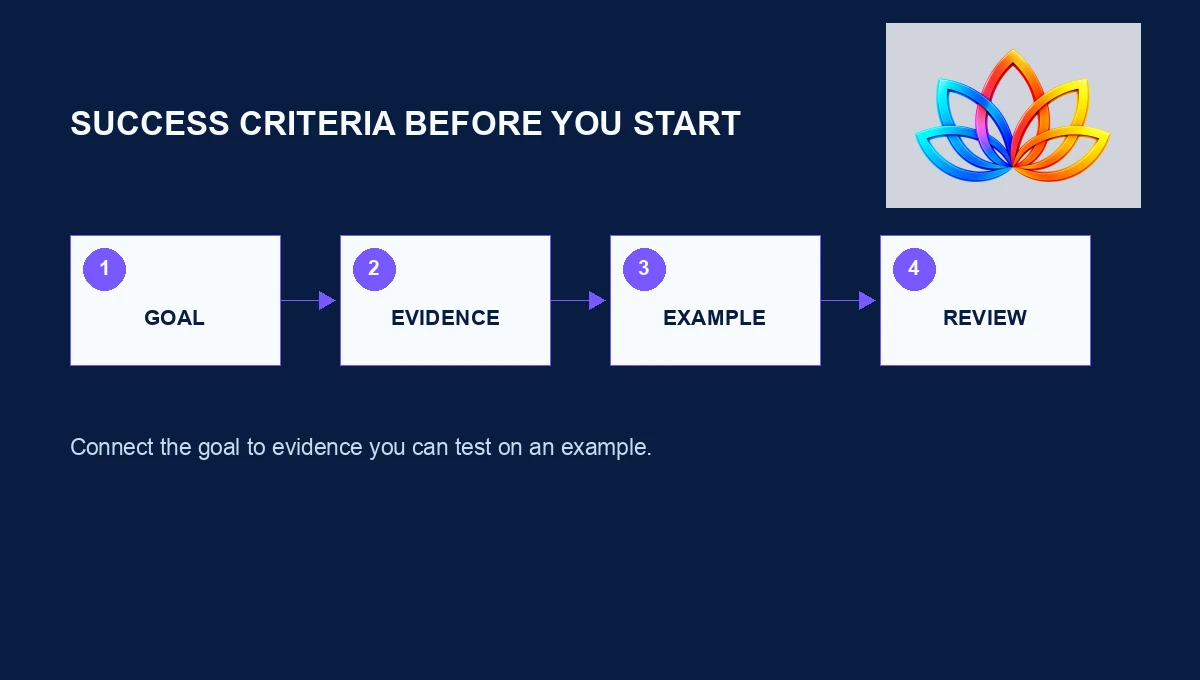
Separate the goal, activity and verifiable evidence of a good result before spending time on production.

“Do it well” is not a criterion. It is an expectation without visible evidence. When a learner or team member starts without a clear picture of a good result, quality is often judged only at the end, when the time for meaningful change has already been spent. Success criteria turn a vague judgement into statements that can be observed, checked and explained.
This guide adapts the educational idea of success criteria to independent learning and everyday work. New South Wales Department of Education material distinguishes a learning goal from an activity and describes criteria as concrete, measurable and observable indicators. This is not a universal formula for every domain; it is a practical way to clarify evidence of a good outcome before work begins.
1. Separate the goal, activity and criterion
A goal answers what should be understood, performed or produced. An activity describes what you will do: read a chapter, build a table, deliver a presentation or write a report. A success criterion states what evidence shows that the goal has been met. If all three are collapsed into “make a presentation”, you still do not know whether accuracy, argument structure, source use or clear explanation matters.
Write the goal in one sentence, then list the activities separately. Next, add only a few criteria about the outcome. For example: the goal is to explain cause and effect; the activity is to draw a diagram; the criterion is that every connection in the diagram has a source-based explanation. A useful criterion does not reward mere busyness or behaviour such as “I stayed focused”.
| Element | Question | Example |
|---|---|---|
| Goal | What should be learned or produced? | Explain causes of a change |
| Activity | What will I do? | Create a diagram |
| Criterion | What evidence shows quality? | Every link has an explanation and source |
2. Turn vague quality into observable evidence
Words such as “clear”, “high-quality”, “detailed” and “professional” may remain in a description, but they are not sufficient by themselves. Ask what two people could see and consistently confirm. Instead of “the text is clear”, write that the introduction states the main question, each section develops one idea, and the conclusion answers the opening question. Instead of “use good sources”, identify which claims require a source and what the source must support.
A criterion does not have to be numerical. Observable means that a trace exists: an example, comparison, accurate connection to a source, completed step, justification or successful test. Begin with a verb that describes evidence — explains, compares, shows or verifies — and add the object being checked. Apply it to a small example. If you cannot decide reliably whether the example passes, the wording remains too vague.
3. Use product and process criteria
Product criteria describe what remains at the end: an accurate answer, complete report, working prototype or justified decision. Process criteria describe actions that contribute to a dependable result, such as checking an assumption, comparing two sources or testing a representative example. Both can matter, but label them so effort is not confused with outcome quality.
For a high-risk task, process criteria may be mandatory even when the final result looks correct. For a creative task, excessively narrow criteria can constrain legitimate solutions. Define the minimum that protects the goal, then leave room for choice. If a criterion requires exactly one format without a reason, check whether it measures presentation rather than knowledge or value.
4. Test the criteria on examples before work
Choose one weak, one borderline and one strong example. Apply the criteria without adding an oral explanation. If the same example sometimes passes and sometimes fails, add more precise evidence or remove ambiguity. If every example passes, the criterion may not distinguish quality. If none passes, the demand may exceed what the goal or available time justifies.
Run this trial before full production. After submission, improve criteria for the next cycle, but do not silently change the rules for completed work. When another person will evaluate the result, confirm their interpretation and request an example of the expected level. This reduces guessing without removing the need for professional judgement.
5. Use criteria for self-checking and feedback
Criteria are not only a final scoring sheet. Open them at a checkpoint during the work and record the evidence currently available for each one. Do not mark only yes or no; name the section, test result, example or source. When evidence is missing, the next action becomes more specific than the general instruction to “improve it”.
When requesting feedback, ask a question tied to a criterion: “Does the conclusion answer the opening question, and where do you see that?” This is more useful than “Do you like it?” Feedback may reveal that the criterion is poorly written, the evidence is missing or the goal itself is wrong. Those three findings require different changes.
6. Apply the method to one real task
Choose a task you can complete in the next few days. Write the goal without describing the activity, list the activities separately, then add three to five criteria. Mark which describe the product and which describe the process. For each, add acceptable evidence and one example that would fail. If the list grows long, return detailed instructions to the procedure or notes.
After the work, record which criterion helped a decision, which was unclear and what was missing. Change only what has a concrete reason. The aim is not a perfect form; it is a verifiable agreement before work begins that guides choices while the result is being made.
- Write the goal separately from the activities.
- Replace vague adjectives with observable evidence.
- Separate product criteria from process criteria.
- Test the criteria on weak, borderline and strong examples.
- Connect every criterion to real evidence during the work.
- After the task, record the reason for each revision.
7. Frequently asked questions
How many criteria are enough?
There is no universal number. Start with the smallest set that covers the essential qualities of the goal and can actually be used during the work.
Must a criterion contain a number?
No. It can be qualitative when it describes observable evidence that people can recognise and explain consistently.
Are success criteria the same as a checklist?
Not exactly. Criteria describe evidence of a good outcome or process; a checklist confirms that critical steps were not skipped.
Who sets the criteria?
In education, a teacher may set or co-develop them with learners. At work, the task owner and the people who create or use the result should align them.
Can criteria change?
Yes, when evidence shows that they are unclear or wrong, but explain the change and do not apply it retroactively without agreement.
What if quality cannot be fully described?
State the verifiable minimum, add representative examples and identify where professional judgement remains.
8. Conclusion
Success criteria turn “do it well” into visible evidence. Separate the goal, activity and criterion; describe the product and important parts of the process; test the criteria on examples; and use them during the work. Final evaluation then becomes an expected part of the process rather than a late surprise.
Sources: NSW Department of Education: Designing the assessment, NSW Department of Education: Sharing success criteria. Accessed 18 November 2026.
About Meta Life Vision
Meta Life Vision is an educational brand within Yevt Group. YEVT DIGITAL works on the Meta Life Vision website and provides website development and other digital solutions.