
Learning
Spaced Learning: Return to Material Before You Forget It
Define what you need to retrieve without help, schedule short returns and adjust the next gap to the observed result.

One long encounter with material can feel fluent, but that feeling is not the same as being able to retrieve the knowledge days later. Spaced learning means returning to the same material in several separate sessions, with time between them.
Research generally finds an advantage for distributed over massed practice, but it does not provide one perfect schedule for every subject and learner. A useful plan therefore starts with the date when the knowledge must be available and a brief check of what you can still retrieve independently.
1. Separate learning from familiarity
Reading the same passage several times in a row makes its sentences feel familiar. That can ease immediate processing without showing how you will respond when the book is closed. A gap creates a small, useful difficulty: some of the material is no longer in front of you and must be reconstructed from memory.
Meta-analytic evidence indicates that the relationship between spacing and later recall also depends on how long the knowledge must be retained. “Always use a longer gap” is therefore not a sound general rule. A gap can be too long to leave enough support, while a very short gap may simply extend one massed session.
2. Define the goal and first return
Write what you want to do without help: explain a concept, solve a problem type, distinguish two ideas or apply a procedure. Then note the real date when you will need that knowledge. The date is a boundary for the plan, not evidence that a mathematically perfect schedule exists.
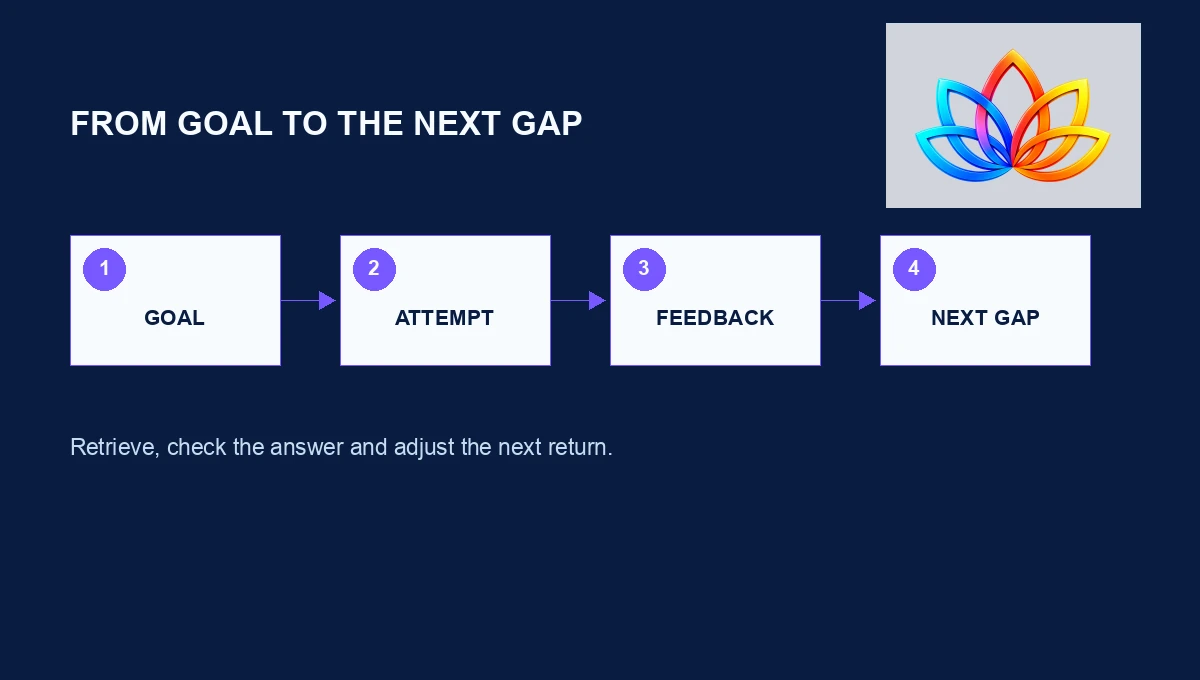
Schedule the first return after the material is no longer completely fresh but before it has disappeared. New, difficult material may need an earlier return than familiar content. After each check, adjust the next gap to the response you actually produced rather than a fixed sequence chosen in advance.
3. Try first without notes
A return session is more than rereading. Close the material and write three key points, sketch the process or solve a small problem. Only then open the source and mark what was correct, what was missing and where two ideas were connected incorrectly.
This step links the schedule to feedback. Rereading alone makes it hard to separate retrieval from recognition. An unaided attempt turns an error into evidence for the next short session instead of a reason to repeat the entire source from the beginning.
4. Use units you can actually check
A broad instruction such as “learn the chapter” is not a useful scheduling unit. Divide it into questions, concepts, procedures or representative problems. Each unit needs a clear answer to: “How will I know I can do this without looking?”
Use a small set of units on each return. Items you can explain accurately may receive a longer gap. Bring weak items back sooner and add a concise explanation. Avoid answering the same card repeatedly in one sitting simply to produce a streak of correct responses.
5. Avoid five common mistakes
Common mistakes include creating too many cards, memorising answers by position, copying whole notes onto a card, relying only on recognition and following an algorithm blindly. A tool can keep records, but it cannot decide for you whether a prompt requires a meaningful answer.
Spaced learning is not a substitute for understanding, complex practice or real application. Facts may fit a short prompt, while a skill often requires a complete task, feedback and varied examples. The schedule should serve the content, not the other way round.
6. Run a seven-day pilot
Choose one small topic and run a seven-day pilot. The aim is not to prove that this exact schedule is optimal. It is to observe what happens when you return after a genuine delay. Keep the total time short enough for the plan to survive alongside other commitments.
After the pilot, inspect the record: which units remained available, where you needed to reveal the answer and whether the prompts were clear enough. Change only one thing—the unit size, question type or gap—and repeat.
- Day 1: learn a small set and write retrieval prompts.
- Day 2: answer without notes and correct errors.
- Day 4: revisit key units and add one new example.
- Day 7: check the whole set in a different order.
- Record what was correct, partial and incorrect.
7. Frequently asked questions
Is there an ideal sequence of intervals?
No single sequence is established for every learner, topic and deadline. The gap depends on difficulty, prior knowledge, performance and the time until real use.
Do I have to use flashcards?
No. Use short questions, problems, diagrams drawn from memory, spoken explanations or practical demonstrations.
What if I have forgotten everything?
Reduce the unit, briefly rebuild the foundation and return sooner. A complete block suggests that the current gap or amount was too large.
Is rereading ever useful?
Yes, when correcting an error or clarifying a passage. It becomes a problem when it is the only form of checking.
How should I space a complex skill?
Space complete attempts, and preserve feedback and representative tasks between sessions. Do not reduce a complex skill to isolated facts.
When can I lengthen the gap?
When you can produce an accurate answer in your own words without substantial help. Return earlier when the answer is fragile or incomplete.
8. Conclusion
Spaced learning is a way to plan a return before knowledge becomes urgently needed. Define what you must do without help, divide the material into checkable units, attempt retrieval before looking and adjust the next gap to the observed result. Research supports distributed practice, but a good personal plan remains a process of measurement and adjustment rather than blind adherence to a universal calendar.
Sources: Mawson and Kang, 2025, Cepeda et al., 2006, Pavlik et al., 2022. Accessed 14 November 2026.
Connect your return schedule to a short retrieval check without notes.
About Meta Life Vision
Meta Life Vision is an educational brand within Yevt Group. YEVT DIGITAL works on the Meta Life Vision website and provides website development and other digital solutions.