
Learning
Self-Explanation: Why Each Step in an Example Makes Sense
Turn a worked example into testable understanding by linking one key step to its principle, boundary and a new use.

A worked example can feel completely clear while it is in front of you, yet the knowledge may fall apart as soon as the task changes. Self-explanation addresses that gap: after an important step, pause and explain in your own words why it is justified, which principle supports it and where that principle stops applying.
This is not a promise of rapid progress or a substitute for practice. It is a way to turn passive following into testable understanding. A study with 56 bank apprentices found that elicited, more sophisticated self-explanations supported transferable knowledge, while the assumption that multiple examples were automatically better was not supported.
1. Following a solution is not explaining it
When a finished example is visible, recognizing the next move can feel easy. Recognition is not the same as producing the move independently. Asking “why now?” forces a link between the visible action and a rule. If you cannot state that link without copying the example, you may still be following its surface.
A useful explanation has three parts: what changed, which rule justifies the change and which condition limits the rule. “We divided by 12” is incomplete unless it also explains why 12 is the relevant unit in that task.
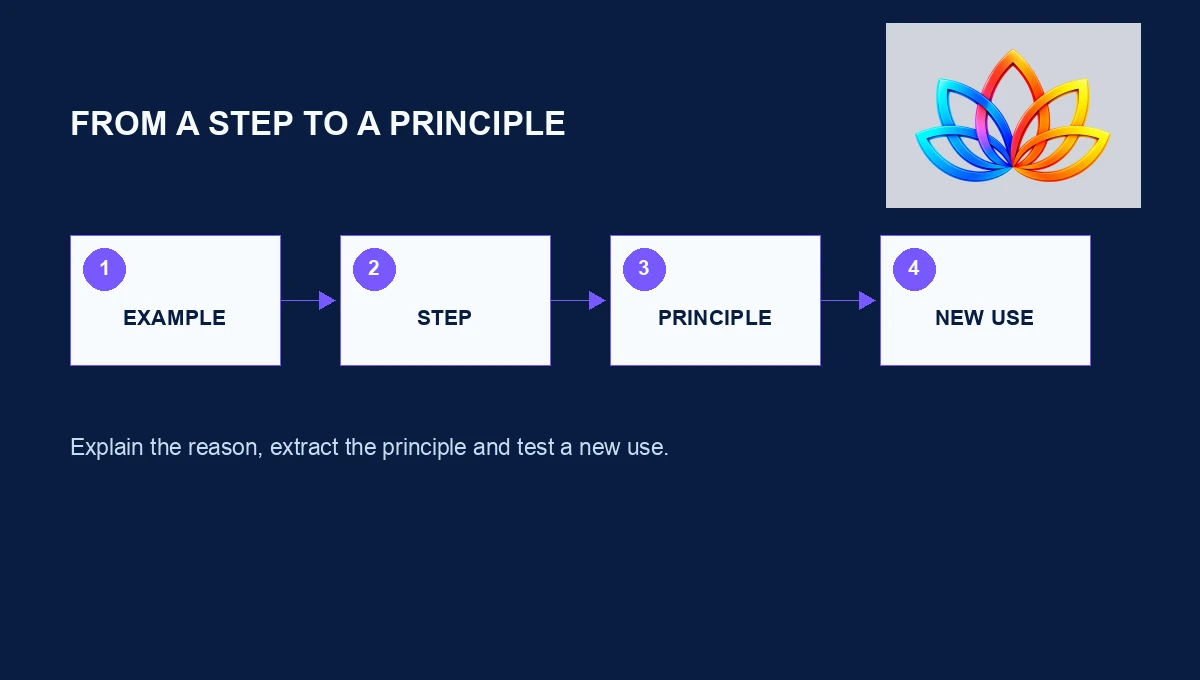
2. A framework: example, step, principle, new use
Take one worked example and select one decisive step. Write: “This step was taken because…”. Extract the broader principle, then create a new situation where the same principle could work. Finally add a boundary: “I would not apply this when…”.
This sequence discourages paraphrase. The goal is not a longer commentary; it is a clear path from one concrete move to a transferable rule.
3. Prompts that direct attention
For a mathematical or technical example, ask: “Which prior fact makes this step possible?” and “How could I check the result another way?”. For a text or argument, ask: “Which evidence supports the conclusion?” and “What fact would change it?”. For a procedure, ask: “Which signal triggers this action?” and “What must be checked before the next step?”.
A research review on explanation prompts warns that a prompt needs to focus attention on relevant content and align with the intended outcome. A vague “explain” can produce many words without producing a useful check.
4. An illustrative worked example
Imagine an example that compares two offers by first converting their prices to the same unit. The self-explanation is not “the price was calculated”. A better version is: “The prices were converted to the same unit because only then are like quantities compared; if the packages differ in quality or terms, unit price alone is insufficient.”
Now create a new use: compare two subscriptions per month. The boundary still matters because included services can change the decision. This is illustrative; an actual choice requires checking the actual terms.
5. Common errors and repairs
The first error is narration: “then the next step happened”. Repair it by adding the reason and boundary. The second is inventing a rule that sounds plausible; check it against the source or feedback. The third is explaining every tiny move and creating fatigue. Focus on junctions where the wrong principle would change the result.
A fourth error is explaining your own incorrect solution without a check. Research indicates that self-explaining an incorrect own solution can, in some conditions, be less useful than explaining a correct solution or comparing correct and incorrect procedures.
6. Next step: a five-minute card
Choose one worked example from today. Record the decisive step, reason, principle, boundary and one new use. Then close the example and attempt the new use without looking. Mark what you could not explain and return only to that part.
Date the card. After several days, repeat the new use. The record does not prove progress by itself, but it makes the check more concrete than the feeling that the material looks familiar.
7. Frequently asked questions
Does self-explanation have to be spoken aloud?
No. It can be a short written note, a spoken explanation or a conversation, provided the reason and boundary remain explicit.
How many steps should I explain?
Start with one or two decisive steps. The quality of the link to a principle matters more than commenting on everything.
Is asking “why” enough?
Not always. A more precise prompt should point attention to a rule, evidence, check or boundary.
What if I do not know whether my explanation is correct?
Label it as a hypothesis and check it against a reliable source, instructor or verified solution.
Should I use many examples?
Not automatically. Additional examples help when their relevant differences are compared and explained.
Can the method be used outside study?
It can support procedures and decisions, but it does not replace professional review when medical, legal, financial or safety consequences are involved.
8. Conclusion
Self-explanation makes one small change to working with an example: ask not only what happened, but why, under which principle and within which boundary. Begin with one key step and one new use. Judge progress by an attempt without the example, not by familiarity.
Sources: Renkl et al., Learning from worked-out examples: the effects of example variability and elicited self-explanations; Rittle-Johnson and Loehr, Eliciting explanations: Constraints on when self-explanation aids learning. Accessed November 11, 2026.
About Meta Life Vision
Meta Life Vision is an educational brand within Yevt Group. YEVT DIGITAL works on the Meta Life Vision website and provides website development and other digital solutions.