
Learning Systems
Questions Before Study: Use an Attempt to Guide Attention
Set a few targeted questions, attempt without grading and check untested ideas too.

A question posed before the first reading can change how attention is allocated. Instead of only moving through the text, the reader attempts an answer and then notices relevant evidence when it appears. The attempt is not a knowledge grade and should not be framed as a pass-or-fail test.
Research calls this practice prequestioning or pretesting. A meta-analysis by Pan and colleagues found the most reliable benefit for content directly targeted by the earlier questions, while transfer to untested content was limited. A sound routine therefore combines a few targeted questions, prompt access to correct information and a final check that includes at least one important idea that was not prequestioned.
1. Decide what each question should direct attention toward
Before reading, identify three to five central ideas. Ask about a relationship, cause, criterion or decision rather than an incidental detail. For a process, ask what triggers the next phase and how success is checked. For a comparison, ask which criterion separates the concepts.
Also identify one important idea that will not become a prequestion. It will later test whether attention became too narrow. This matters because prequestions do not guarantee uniformly better memory for the whole material.
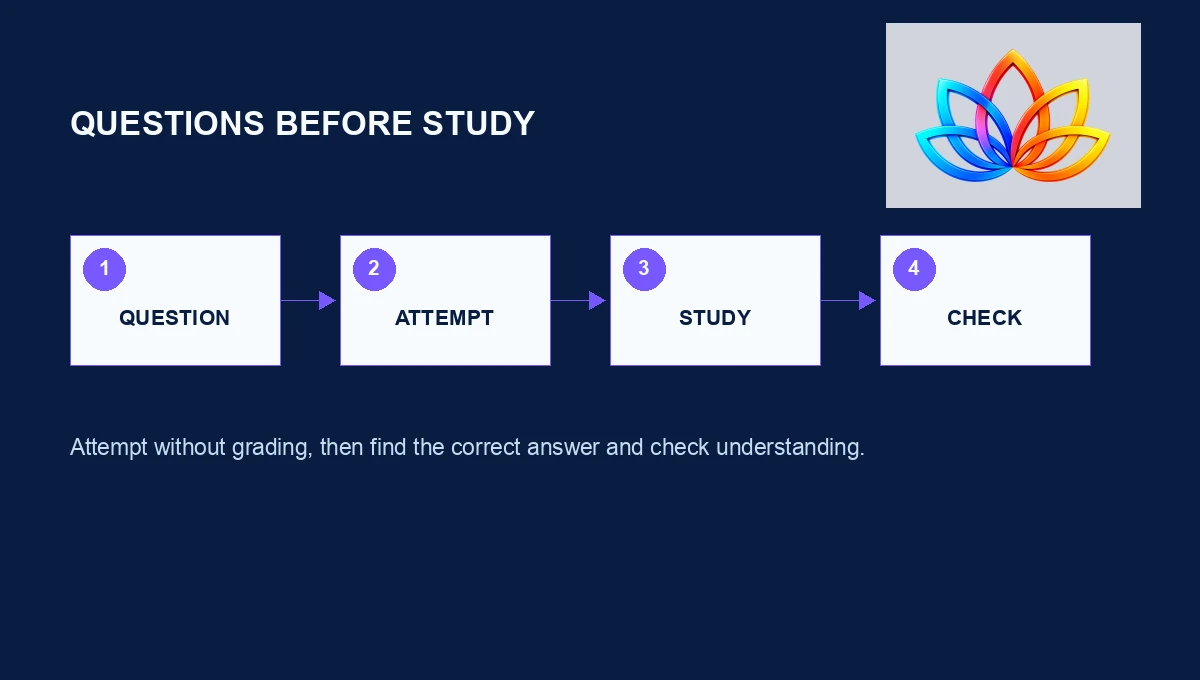
| Phase | Action | Evidence |
|---|---|---|
| Question | Set 3–5 targeted questions | Questions cover central ideas |
| Attempt | Answer without grading | Initial model is recorded |
| Study | Find the correct answer and rationale | Evidence is marked in the source |
| Check | Answer tested and untested ideas | Gaps and next action are identified |
2. Separate the attempt from assessment
Make a brief attempt even when uncertain. Record the current answer and confidence, but assign no score. The purpose is to activate prior knowledge and create a problem that the material can resolve. An evaluative atmosphere can add anxiety and encourage indiscriminate guessing.
Frame the attempt as a working hypothesis: “I currently think… because…”. This separates the idea from the learner’s identity. Revising the answer when evidence appears becomes an expected part of learning rather than an admission of failure.
3. Study the correct answer and its evidence promptly
After the attempt, use the source. For each question, locate information that confirms, corrects or limits the initial answer. Do not stop at a short answer: record the reason and the conditions under which it applies. Carpenter and Toftness describe subsequent study of the correct information as part of prequestioning; an incorrect attempt without correction is not a complete routine.
Link each answer to a specific paragraph, diagram or example. If the source is insufficient, label the question open rather than filling the gap with an assumption. The prequestion then remains a reading tool, not a reason to make an unsupported claim.
4. Check content that was not prequestioned
At the end, answer the original questions again without looking at the text. Then explain the untested central idea selected earlier. If targeted answers are strong but the untested idea is absent, broaden the next question set or preview the overall structure before studying details.
This control prevents several correct answers from being mistaken for understanding of the whole domain. The limited general-transfer finding calls for a narrow interpretation: a prequestion may efficiently direct attention to its target, but it does not replace a comprehensive final check.
5. Avoid guessing without corrective feedback
Weak prequestions focus on trivia, have ambiguous criteria or are so numerous that reading becomes a hunt for phrases. Another failure occurs when the initial response remains memorable while the correction is skimmed. Limit the question set, require a reason and explicitly compare the old and new answers after study.
Do not use unsupported trial answers where an error could cause immediate harm without expert supervision. Provide reliable instruction and procedures first. In ordinary learning, match difficulty to prior knowledge: the question should be challenging but clear enough to guide attention.
6. Run a short cycle and preserve the learning trace
Choose four questions for one session. Spend about two minutes on initial answers, then study the material and mark evidence for each. Close the source, answer again and add one question about an untested section. The timing is an organisational example, not a universal quality threshold.
Keep the initial answer, the final evidence-based answer and one unresolved point. Revisit that point next time and change questions that proved too narrow. Measure progress through explanation quality and application to a new example, not the number of confident guesses.
- Choose three to five central questions.
- Write an ungraded attempt with a confidence estimate.
- Study the correct answer and mark its evidence.
- Answer again without viewing the source.
- Check at least one untested central idea.
- Preserve the correction and the next question.
7. Frequently asked questions
Does a wrong initial answer harm learning?
Not necessarily when a clear correct answer and rationale follow promptly. An attempt without correction is insufficient.
How many questions should be used?
There is no universal count. Begin with a few questions that cover central relationships rather than every detail.
Do prequestions improve learning for the whole text?
The most reliable benefit concerns directly targeted content. Include untested ideas in the final check.
Should the attempt be graded?
Not in this routine. It activates knowledge and guides attention rather than ranking learners.
When should the questions change?
Change them when they can be answered without understanding, target only trivia or leave a central idea unnoticed.
Is this the same as retrieval after study?
No. This attempt comes before study; post-study retrieval checks and strengthens content that has already been studied.
8. Conclusion
Questions before study can turn a first reading into a directed search for evidence. Their value lies not in initial accuracy but in correction, explanation and the final check. Keep the scope narrow, study correct information promptly and test content that the questions did not target.
Sources: Pan i saradnici: meta-analiza efekta pitanja pre učenja, Carpenter i Toftness: pregled pitanja pre učenja, Pan i saradnici: poređenje pretestiranja i naknadnog testiranja. Accessed 21 November 2026.
Continue with a guide to checking confidence and retrieval after study.
About Meta Life Vision
Meta Life Vision is an educational brand within Yevt Group. YEVT DIGITAL works on the Meta Life Vision website and provides website development and other digital solutions.