
Learning
A Learning Error Log: Turn a Wrong Answer into the Next Practice Task
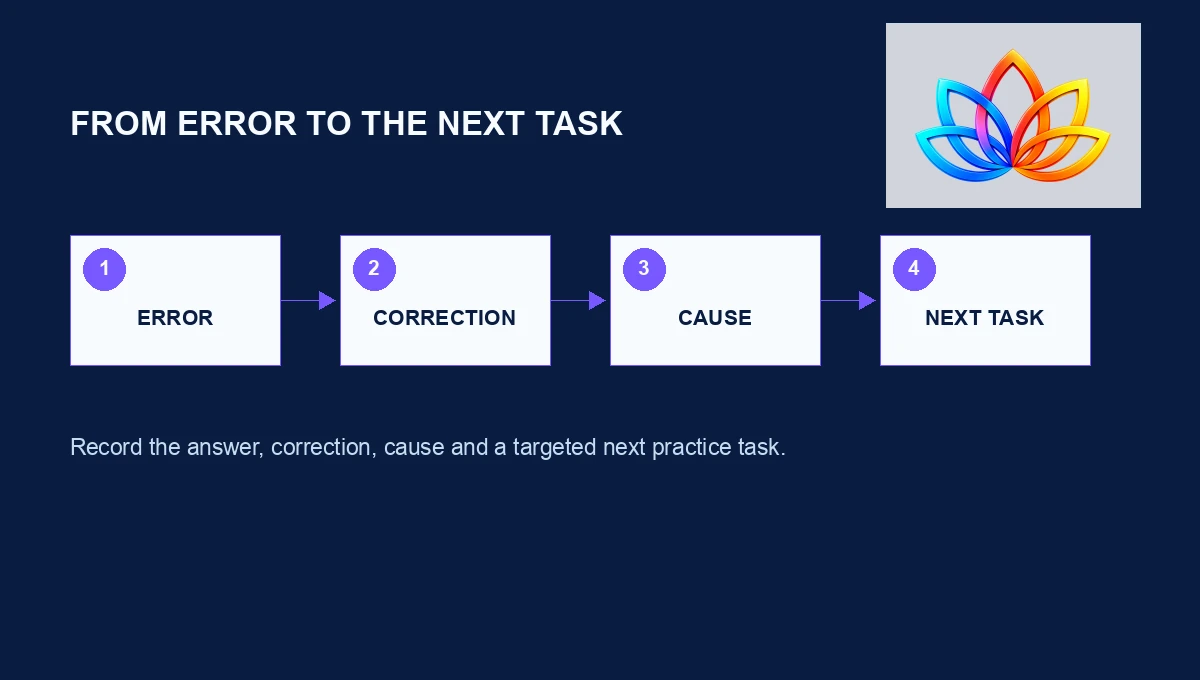
Record the actual response, correction and likely cause, then create targeted follow-up practice.

A wrong answer is not automatically evidence that learning has failed. It becomes useful when you preserve enough detail to see what went wrong, verify the correction and design a task that targets the same problem.
Research on learning from errors and feedback shows that benefits depend on how correction is given, when feedback arrives and how the reason is processed. An error log is therefore not a punishment list or universal formula. It is a short working record: response, correction, likely cause and next check.
1. Preserve the actual response, not only the score
Record the question or task condition and the answer you actually gave. “Incorrect” alone does not reveal whether you misunderstood a concept, missed a condition or made a procedural error. Keep the decisive step rather than every line when the rest adds no value.
Add the date and task source. Repeated entries can then distinguish an isolated slip from a pattern. Do not polish the original response after seeing the solution; the record must preserve the unaided decision.
2. Write the correction in your own words
Check a reliable source or worked solution, close it and write the correction in your own words. Copying the finished answer does not show whether you understand the link between the condition and procedure. In a calculation, mark the first step where your route diverged.
Keep the correction brief enough to review and clear enough to restore the rule. If you cannot explain why it is correct, return to the source or seek feedback before marking the entry resolved.
3. Identify a likely cause without rushing to label yourself
A cause may be missing knowledge, a misread condition, confusion between similar concepts, an incorrect sequence or premature confidence. These labels are practical prompts, not diagnoses. Choose one only when it connects to evidence in the response.
If uncertain, write “cause not confirmed” and test it with a similar example. One wrong answer does not justify a broad claim about ability. Repetition across several tasks is stronger evidence that practice should change.
4. Turn the cause into the next task
The next task should test the same rule in a slightly different context. If you missed a condition, the new example should require you to identify it. If you confused concepts, compare examples and explain the distinction before solving.
Do not repeat an identical answer many times immediately. Attempt one targeted example unaided, check the outcome and record whether the cause recurred. If it did, reduce complexity and rebuild the foundation; if not, test transfer later.
5. Review patterns once a week
Group entries by likely cause and content once a week. Look for a few repeated patterns rather than perfect statistics. Three unrelated conceptual errors do not necessarily need one remedy, while the same confusion in three tasks deserves targeted practice.
Close an entry only when you can solve a new example and explain the key step without looking. Record the review date so the log remains a decision tool rather than an expanding archive of guilt.
6. Start with four fields
One table or notebook page is enough. Avoid elaborate scoring until the basic record proves useful. The valuable part is not the number of errors collected but the link from cause to next task.
After seven days, ask whether the entries help you choose practice. Shorten descriptions that are too long; add a clearer condition or key step when old entries make no sense.
- The actual response or decisive wrong step.
- A correction written in your own words.
- A likely cause, marked when unconfirmed.
- One next task and a review date.
7. Frequently asked questions
Should I record every error?
No. Record errors that reveal misunderstanding, a repeated pattern or an important missed condition. Briefly mark minor slips.
Is the correct answer enough?
No. Without the actual wrong step and likely cause, choosing targeted practice is difficult.
When should I seek feedback?
When you cannot reliably determine the correction, reason or standard of accuracy.
What if the error returns?
Reduce complexity, rebuild the basic rule and use another example that isolates the problem.
Must the log be digital?
No. A notebook, table or document works if you can review it easily.
When is an entry complete?
When you solve a new example accurately and explain the key step without looking.
8. Conclusion
An error log is useful only when it leads to a next decision. Preserve the actual response, write the correction in your own words, identify a likely cause without overclaiming and create one targeted task. A weekly review closes entries with evidence from a new example, not merely the feeling that the answer now looks familiar.
Sources: Metcalfe, 2022, Wisniewski et al., 2020, Steuer et al., 2016. Accessed 15 November 2026.
Connect your error log to a short retrieval check without notes.
About Meta Life Vision
Meta Life Vision is an educational brand within Yevt Group. YEVT DIGITAL works on the Meta Life Vision website and provides website development and other digital solutions.