
Learning Systems
Interleaved Practice: Learn to Select a Method, Not Just Repeat It
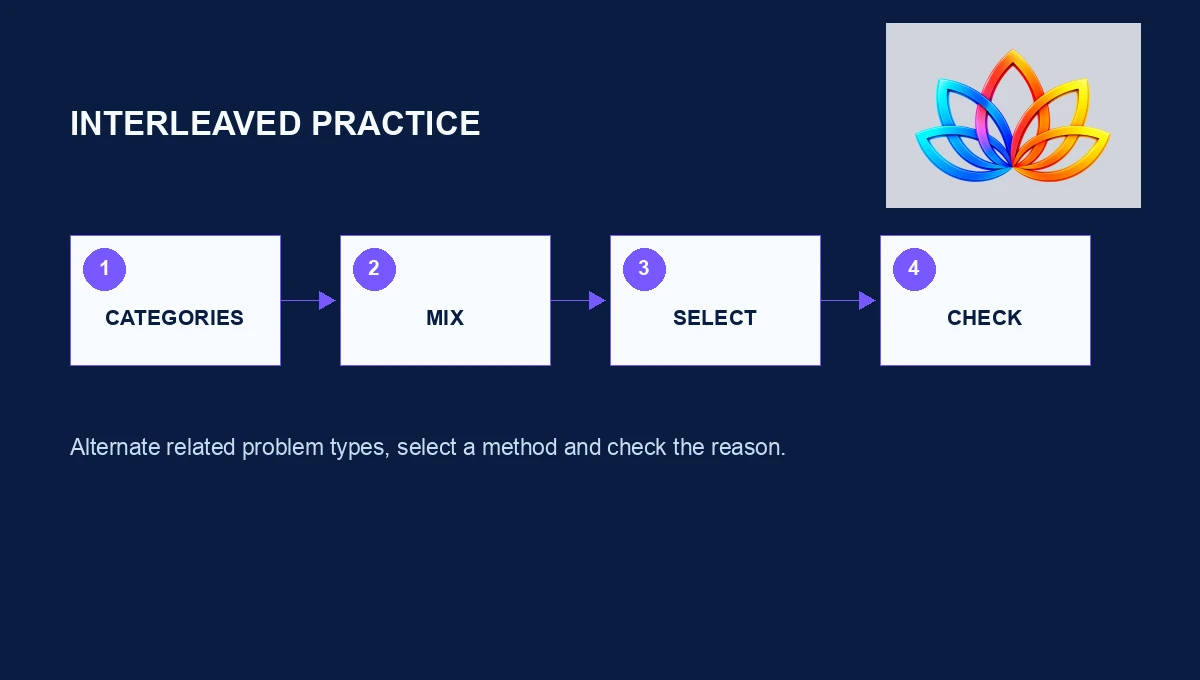
Mix related problems so method selection becomes part of practice, with a rationale and delayed check.

When a learner solves ten problems of one type, the next method is obvious: it is the method just practised. A mixed test creates a different demand. Before calculating or writing, the learner must identify the problem type and select an appropriate method. Interleaved practice deliberately introduces that decision.
Research does not justify claiming that interleaving is always better. Foster and colleagues found that both contrast among related categories and distributed practice can contribute to mathematics learning. Carvalho and Goldstone showed that the result depends on category structure: alternation may highlight differences, while blocking may highlight similarities within a category. Introduce a new method clearly first, then interleave only related problems the learner must distinguish.
1. Choose related types that are easy to confuse
Begin with three or four categories that require different methods but share surface features. These might be related equation types, grammatical constructions or business requests with different approval routes. Mixing unrelated tasks mostly adds noise.
If a method is entirely new, show several clear examples of that type first. The blocked introduction establishes the steps. The following mixed set asks the learner to recognise when those steps apply without a category label.
| Phase | Order | Evidence |
|---|---|---|
| Intro | Examples of one type | Steps understood |
| Contrast | Two types side by side | Difference stated |
| Mixed | Related types, no labels | Method selected first |
| Transfer | New delayed example | Selection retained |
2. Teach cues for selection, not only procedures
For each category, identify observable cues that change the decision. Ask not only “How is this solved?” but also “How do you know this method fits?” A brief rationale before work reveals whether an error came from classification or execution.
Contrast pairs that look similar but differ in one important condition. The learner marks the condition, selects a method and only then solves. Feedback should correct selection and execution separately.
3. Build an intentional mixed set
Create twelve items, four from each of three related categories. Where practical, avoid placing the same category twice in a row. The order need not be perfectly random; what matters is that labels do not disclose the method and each item requires a renewed decision.
Before each item, record the method and one reason. After solving, record two outcomes: whether selection was correct and whether execution was correct. A wrong answer then becomes a diagnosis rather than one undifferentiated score.
4. Combine interleaving with spaced checks
A mixed set can also distribute categories over time, so the effects of contrast and spacing may overlap. Plan another check in a later session rather than judging only fluency during practice. Faster blocked performance is not necessarily evidence of better long-term selection.
Change surface details at the delayed check while preserving the criteria that determine the method. If the learner remembers order instead of criteria, use a different sequence. If one category remains weak, return to one concise example and then restore it to the mixed set.
5. Do not treat difficulty or confidence as proof
Mixed practice often feels slower because every item requires classification. That effort may be purposeful, but it is not automatic evidence of learning. Foster and colleagues reported in 2023 that improved task performance after interleaving did not necessarily produce more accurate judgments of learning.
Use delayed performance, correct method selection and the learner’s rationale. Record confidence separately from accuracy. Rising confidence without better selection calls for clearer criteria and feedback, not merely more of the same mixture.
6. Run one auditable cycle
Introduce three methods with clear examples. Build a cue table, compare two boundary cases and run the mixed set. Preserve the selection, reason, execution and confidence for each item. Report selection errors separately from execution errors.
In the next session, use new examples without category headings. Expand by one related category only when selection and explanation are reliable. Otherwise reduce the number of categories and sharpen the contrast.
- Choose three or four related categories.
- Introduce each new method with a clear example.
- Record the cues that govern selection.
- Mix categories without method labels.
- Require a selection and reason before execution.
- Check with new examples in a later session.
7. Frequently asked questions
Should problems be interleaved from the start?
Not necessarily. Introduce an entirely new method clearly, then mix related types to practise selection.
Must the order be random?
No. It must prevent automatic repetition and require renewed decisions while keeping categories adequately represented.
How many categories should be included?
There is no universal number. Start with a small related set and expand only after selection is reliable.
Why does mixed practice feel harder?
The learner must classify the problem and select a method. Difficulty alone is not proof of better learning.
Does interleaving replace spaced practice?
No. They can work together, but the plan should include a later check.
What should be scored?
Record method selection, rationale and execution separately so feedback addresses the actual error.
8. Conclusion
Interleaved practice is most useful when learners know the basic methods but must learn when each applies. Choose related categories, expose their differences, require a decision before work and check it with new examples after a delay. Judge results through actual selection and explanation, not perceived ease.
Sources: Foster et al. (2019): contrast and distributed practice, Carvalho and Goldstone (2014): category structure and study order, Foster et al. (2023): interleaving and metacognitive judgments. Accessed 22 November 2026.
Continue with a guide to worked examples and gradual transition to independent practice.
About Meta Life Vision
Meta Life Vision is an educational brand within Yevt Group. YEVT DIGITAL works on the Meta Life Vision website and provides website development and other digital solutions.