
Learning
Interleaved Practice: When Mixing Problem Types Helps
After initial learning, alternate related problem types to practise recognition, method selection and verification of both decisions.

Practice is often arranged neatly: ten problems of one type, followed by ten of another. This makes it easier to repeat the procedure that was just demonstrated, but it does not always test whether you can identify the right procedure when the problem type is not announced. Interleaved practice changes the order: after the initial introduction to each procedure, related problem types alternate within the same set.
This does not mean that every topic should be mixed at random. Interleaving is most relevant when learners already know the basic procedures and need to distinguish similar problems and select an appropriate method. Research reports benefits in particular settings, but the outcome depends on the material, feedback and implementation.
1. Blocked and interleaved practice
In blocked practice, all type A problems precede type B problems: AAAA, then BBBB. An interleaved set with the same number of problems might be ordered ABAB or ABCBAC. The amount of practice can remain unchanged; what changes is the decision required before calculation or execution.
Blocking can be useful during the first encounter with a new procedure because it reduces the number of simultaneous decisions. Its weakness appears when position reveals the method. Interleaving removes that clue: the learner identifies the problem before applying a method. A systematic review by Chen, Paas and Sweller distinguishes interleaving from spaced learning and links its benefit to discriminating among similar categories.
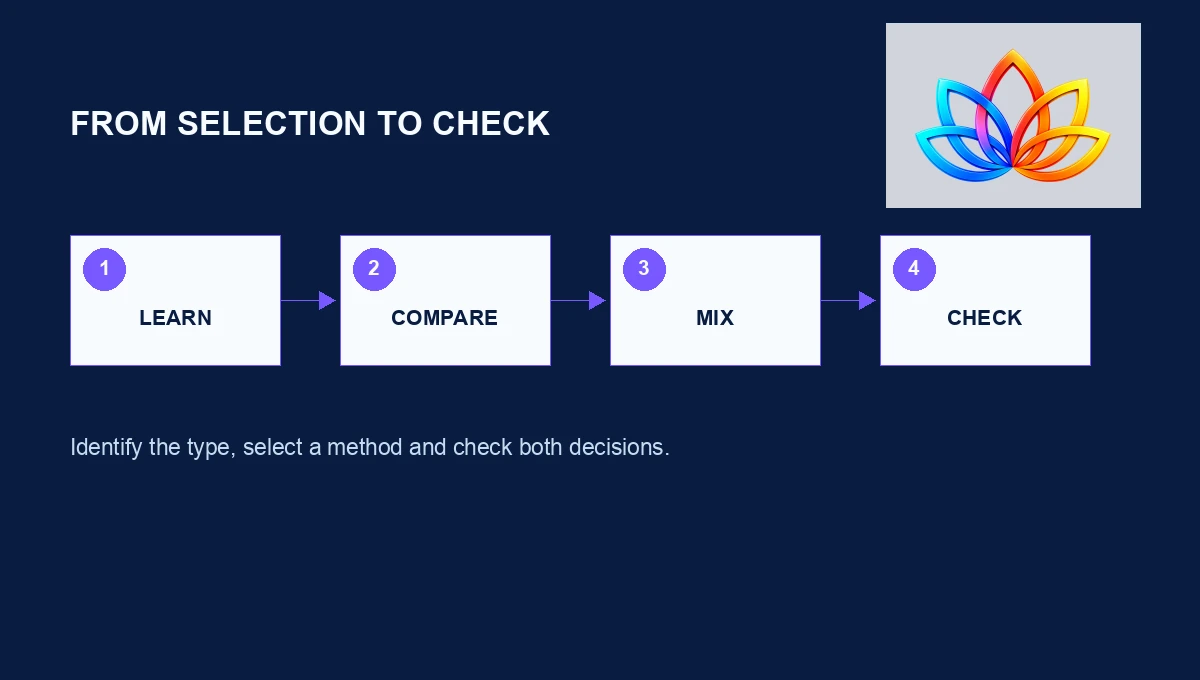
2. A practical framework: learn, compare, mix, check
Begin with a short blocked sequence until the basic steps make sense. Then place two related problem types side by side and record how they differ: which information is decisive, which procedure fits each type and what error would follow from the wrong choice. Only after this comparison should you build a small mixed set.
For every problem, record the decision before doing the calculation: “This is type B because…”. After the attempt, check both the choice of method and its execution. If the method was wrong, the correction should identify the missed cue. If the method was appropriate but the calculation failed, that is a different error and calls for different practice.
3. When mixing is most useful
Interleaving is particularly relevant when problems look similar but require different strategies: selecting a formula, grammatical rule, diagnostic category or data display. In such cases, close comparison can emphasize distinctions that may remain invisible when categories are practiced in separate blocks.
The US Institute of Education Sciences describes a cluster-randomized study involving 787 students in 54 seventh-grade classes. Groups received the same mathematics problems in different orders. On an unannounced final test, the group with more interleaving scored 61%, compared with 38% in the control condition. This is the result of a specific school study, not a promise that the same percentage will apply to another subject, age group or problem set.
4. An illustrative session
Imagine learning three related problem types. First, complete two clear examples of each type with an explanation. Next, create a table with three rows: “cue in the problem”, “appropriate procedure” and “common substitution”. Then select nine problems and arrange them so that the same type does not repeat several times in a row.
- Read the first problem without calculating.
- Name the type and record the evidence for that choice.
- Solve the problem.
- Compare the result with a reliable solution or feedback.
- Mark whether the error concerned selection or execution.
- At the end, repeat one problem from each category you confused.
This example is a trial format, not a required number of problems. Adjust the amount to the difficulty of the material and the available time.
5. Common implementation errors
The first error is mixing too early. If a learner does not understand any of the procedures, an additional selection decision can merely increase confusion. The second is combining unrelated topics that do not support a useful contrast. The third is using a completely random order without a plan, allowing some problem types to nearly disappear.
A fourth error is feedback that shows only the correct answer. Learning to select requires an explanation of why the method fits. A fifth is assuming that harder practice is automatically better. Difficulty is useful only when the learner can process it and receives a sufficiently precise check. A 2026 meta-analysis of authentic school classrooms reports that interleaving effects were moderated by the provision and timing of feedback.
6. Next step: a small comparable trial
Choose two related problem types that you already know. Keep the number of problems and working time similar. Complete a small blocked set on one day and a mixed set on another. After a short delay, take a new mixed mini-test without problem-type labels. Record two outcomes: how often you chose the appropriate procedure and how often you executed it correctly.
Do not declare a winner from one comfortable or uncomfortable feeling. Interleaved work can feel slower because it requires a new decision for each problem. Examine the delayed check and the kinds of errors. If accuracy collapses, return to a short explained example, then reintroduce mixing on a smaller scale.
7. Frequently asked questions
Does interleaved practice mean a random order?
Not necessarily. The order can be planned so that every important type is represented and useful comparisons recur.
Should material be mixed from the first attempt?
It is usually useful to understand the basic steps of each procedure first, then gradually introduce selection among related types.
Is interleaving the same as spaced learning?
No. Spaced learning inserts time gaps between sessions. Interleaving alternates related content; the two can overlap in practice.
How do I decide which problems to mix?
Choose problems that learners could realistically confuse and for which recognizing the problem type is an important part of the knowledge.
What if performance is immediately worse?
Check whether the basic procedures are understood and whether feedback explains the selection. Immediate difficulty is not the same as long-term benefit.
Can this method be used outside mathematics?
It can be used when related categories or procedures must be distinguished, but evidence and implementation should be checked for the specific domain.
8. Conclusion
Interleaved practice does not necessarily add more problems; it changes the decision each problem requires. After initial learning, a mixed set can practice problem recognition and method selection rather than repetition of the last demonstrated formula. Start with two related types, an explicit comparison and feedback that separates selection errors from execution errors.
Sources: Institute of Education Sciences, An Efficacy Study of Interleaved Mathematics Practice; Chen, Paas and Sweller, Spacing and Interleaving Effects Require Distinct Theoretical Bases; Camp et al., A Meta-Analysis of the Effectiveness and Boundary Conditions of Retrieval Practice, Distributed Practice, and Interleaved Practice in Authentic School Classrooms. Accessed November 12, 2026.
About Meta Life Vision
Meta Life Vision is an educational brand within Yevt Group. YEVT DIGITAL works on the Meta Life Vision website and provides website development and other digital solutions.