
Personal Growth
From Intention to Action: How to Make an If–Then Plan
Link a recognizable cue to a concrete response, test the plan in context and adapt it using a real record.

A clear goal does not automatically answer when and how we will begin. We often leave that decision until we are already tired, busy or surrounded by competing demands. An if–then plan links one recognizable situation to one concrete response in advance: “If X occurs, then I will do Y.” It is not a promise of success. It is a way to make the next step less dependent on another last-minute decision.
Why is a good intention not the same as a ready next step?
A goal describes a desired outcome: “I want to finish the presentation.” An implementation intention describes a situation and response: “If I open my laptop at 9 a.m. tomorrow, then I will first write the headings for five slides.” Peter Gollwitzer presented this distinction as a link between an anticipated situation and goal-directed behaviour. Source: Gollwitzer — Implementation Intentions.
A 2024 review covered 642 independent tests of implementation intentions. The authors reported effects across cognitive, affective and behavioural outcomes, with larger effects when plans used a contingent if–then format, participants were strongly motivated to pursue the goal and plans were rehearsed. Results varied across outcomes and studies, so they cannot be turned into a guarantee for an individual. Source: Sheeran, Listrom and Gollwitzer — The When and How of Planning.
Vague intention: “I will work on the important task when I have time.”
If–then plan: “If my morning meeting ends, then I will open the document and write the first section before checking messages.”
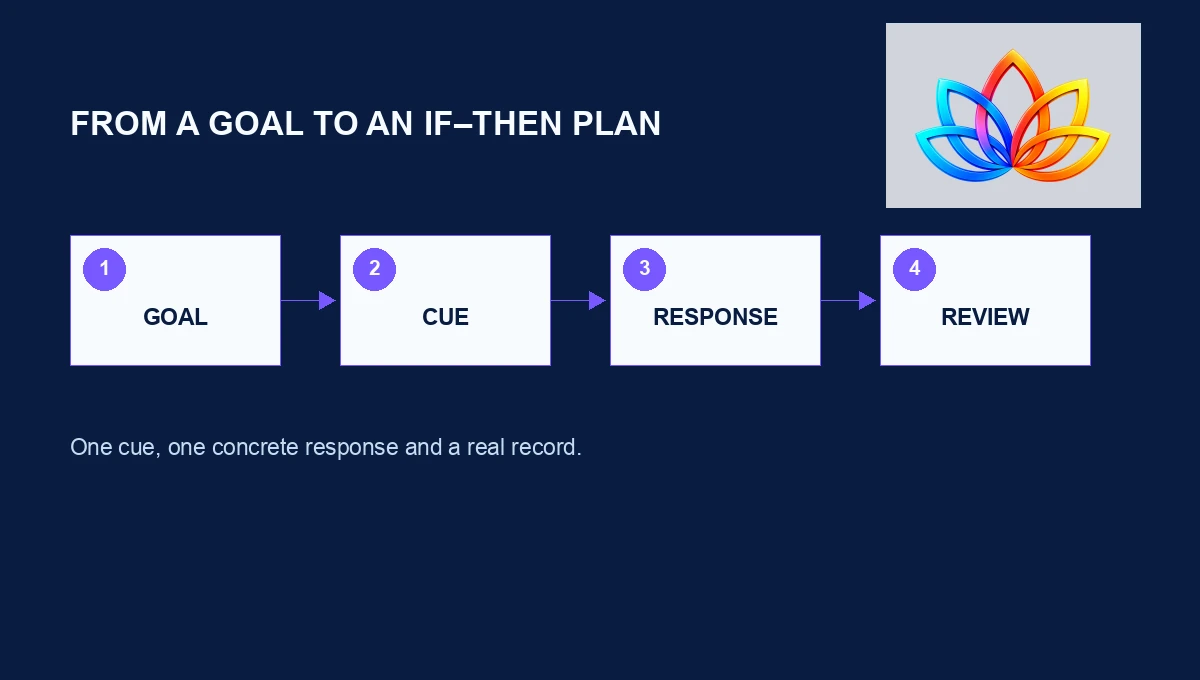
A practical framework: goal, cue, response and review
- Confirm the goal. Choose a goal you genuinely intend to pursue; an if–then plan cannot replace that commitment.
- Find the critical moment. Identify an opportunity to begin or the point where you usually go off course.
- Choose a visible cue. It can be a time, place, completed activity or event you can clearly recognize.
- Define a small concrete response. State what you will do, not only what you will avoid.
- Write one sentence. “If [cue], then I will [response].”
- Review it in context. After several opportunities, record whether you noticed the cue and whether the response was workable.
Task: take one active goal and write only one plan. Underline the cue, circle the response verb and ask: “Without further explanation, would I know that the moment had arrived and exactly what to do?” If not, make the sentence more specific.
Where can an if–then plan be useful?
Starting work
When the problem is delaying the start, the cue can be the end of an existing routine: “If I put away my cup after breakfast, then I will open my notes and write three questions.” The response is small enough to mark a start while remaining directly connected to the goal.
Protecting attention
A plan can connect a typical interruption to a response: “If I notice a new message during focused work, then I will note it for the break and return to the next paragraph.” The response needs to be executable, rather than a broad command such as “do not get distracted.”
Learning and practice
The cue can be a place or the end of a class: “If the lecture ends, then I will write one question from memory before the next commitment.” The plan does not guarantee learning; it only preselects a moment for a useful action.
Business communication
For a recurring meeting, a plan might be: “If the conversation reaches a decision, then I will record the task owner and due date before we move to the next topic.” The cue is an event in the discussion, and the response produces a checkable record.
An illustrative example: from “work on the proposal” to a clear plan
Illustrative example, not a real client or verified outcome: a person wants to prepare a business proposal but opens email first every time. The goal exists, yet the start is not tied to a recognizable moment.
The first draft says, “If I have time, I will work on the proposal.” The cue “have time” has no clear boundary, while “work on” does not identify the first visible action. A more precise version is: “If I sit at my desk at 9 a.m., then I will open the proposal document and write three customer needs before opening email.”
After each opportunity, two things are recorded separately: whether the cue occurred and whether the response began. If the cue was missed, it may not be noticeable enough. If it was noticed but the response did not begin, the action may be too large, depend on something unavailable or conflict with another commitment. The revision should answer the observed problem rather than label it as a lack of willpower.
Common mistakes when writing the plan
- A plan without an accepted goal. A precise sentence cannot solve a conflict about whether the goal matters.
- An invisible cue. “When I feel ready” is difficult to identify; time, place or a completed activity is usually more checkable.
- An oversized response. “Finish the report” may be a project. Start with an action that can clearly begin.
- A negation instead of a response. “I will not check my phone” does not say what to do when the urge appears. Specify an alternative action.
- Too many plans at once. Many cues can become another list you do not follow. Test one important plan.
- No feedback check. Without a record, you cannot tell whether the issue is the cue, response or goal.
Your next step: test one plan, then adapt it
Write the date, goal, if–then sentence and no more than three upcoming opportunities when the cue might occur. For each, mark: cue noticed — yes/no; response started — yes/no; one short note. This is an editorial self-observation exercise, not clinical treatment or a promise of behaviour change.
For a broader framework on turning an idea into a checkable step, continue with How to Turn Knowledge into Practice. That article explains a wider application cycle, while this one focuses on the link between one cue and one response.
Frequently asked questions
Is an if–then plan the same as a goal?
No. A goal describes a desired outcome or behaviour; an if–then plan specifies the situation in which you will start a concrete response that serves the goal.
Must the cue be an exact time?
No. It can be a place, the end of an activity, an event in a conversation or another situation you can reliably recognize.
How many plans should I make?
There is no universal number. For a practical trial, begin with one important plan, review it and add another only when it addresses a clear problem and cue.
What if the cue occurs but I do not perform the response?
Record what prevented it. The response may be too large, insufficiently specific, dependent on a missing resource, or the goal may have lost priority.
Should the plan state what I will not do?
It is more useful to specify a concrete alternative response. Instead of only banning an action, state what you will start when the critical situation occurs.
Does the research guarantee that my plan will work?
No. Research describes patterns across groups and tasks. An individual outcome depends on the goal, context, plan quality and other conditions.
Conclusion: decide the first move in advance
An if–then plan does not remove uncertainty, obstacles or the need to revise a goal. Its practical value is narrower: it decides in advance what you will do when a recognizable situation occurs. Choose one real goal, one cue and one workable response, then review what happened instead of assuming success.
Sources, accessed November 10, 2026: Gollwitzer — Implementation Intentions: Strong Effects of Simple Plans; Gollwitzer and Sheeran — Implementation Intentions and Goal Achievement; Sheeran, Listrom and Gollwitzer — The When and How of Planning. The examples and exercise are editorial suggestions.
About Meta Life Vision
Meta Life Vision is an educational brand within Yevt Group. YEVT DIGITAL works on the Meta Life Vision website and provides website development and other digital solutions.