
Learning Systems
How Well Do You Really Know It? Compare Confidence with a Retrieval Attempt
Separate familiarity from actual recall and use mismatch to choose the next learning action.

Feeling that material is familiar is not the same as being able to retrieve it without help. Immediately after reading, wording and page layout remain accessible, so confidence can rise even when independent recall is weak. A more useful check separates the cue, confidence judgement and retrieval attempt, then records where expectation and result match or diverge.
Research on metacognitive judgements is important but nuanced. Delayed judgements made without the answer in view often discriminate better between items that will and will not be remembered, yet one study found poorer absolute calibration and another found that making delayed judgements alone did not directly improve text learning. Treat this process as a diagnostic record, not a promise that one judgement will improve knowledge.
1. Define exactly what you are predicting
Write a specific claim before testing: “Tomorrow, with only this question, I can explain the concept in my own words and give an example.” Do not ask only whether the lesson feels clear. Present clarity describes an experience; a prediction should name a later action under known conditions.
Keep confidence separate from answer quality. Record confidence on a small scale, but judge the result against independent evidence: required ideas, a valid sequence or an example that genuinely demonstrates the concept. The number is not proof; it preserves your expectation before you see the outcome.
| Confidence / recall | Meaning / action |
|---|---|
| High / successful | Expectation and result align; test later |
| High / weak | Familiarity may mislead; review and explain the gap |
| Low / successful | Knowledge was underestimated; keep the evidence and vary the example |
| Low / weak | Expectation and result align; restudy selectively |
2. Separate cue, confidence, recall and comparison
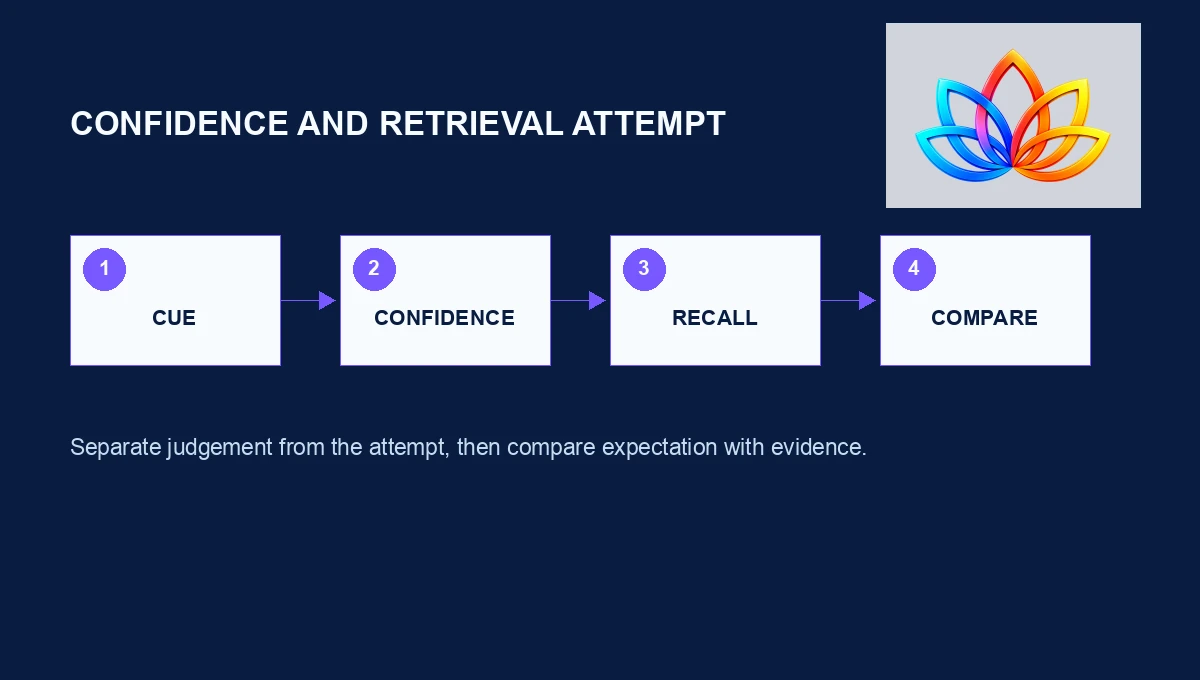
Prepare only a question or short cue, with no answer. Close the source, allow immediate reading traces to fade, read the cue and record confidence before attempting an answer. Respond without opening notes. Only then compare the response with the source or a criterion written in advance.
This order preserves independence. If you answer first and rate confidence afterwards, the rating already contains information about how the attempt felt. If the answer remains visible, you are measuring recognition. There is no universal delay: choose an interval that resembles the real situation in which the knowledge will be needed.
3. Judge the answer with evidence defined in advance
For a concept explanation, require a definition, two important relationships and a new example. For a procedure, require the sequence and a reason for each critical step. For a decision, require criteria, an alternative and a limitation. Write the criterion before attempting the answer so it cannot be reshaped around the response.
Avoid reducing the result to perfect or failed. Record which part is accurate, what is missing and where concepts were confused. This helps distinguish a knowledge gap from a poorly worded cue. If the cue is ambiguous, revise it for the next cycle while preserving the original record.
4. Read mismatch as information, not a verdict
High confidence with a weak answer is the most useful signal to inspect: familiar terms may have been mistaken for understanding, or one example memorised without its principle. Low confidence with a strong answer shows that evidence exists even when the subjective feeling lags. Matching pairs matter too, but do not prove durability over a longer interval.
Look for patterns across several questions. One miss may reflect fatigue, a poor cue or an overly narrow criterion. Repeated overconfidence in one task type supports changing study behaviour: add independent recall, vary examples or explain the cause of the error. Do not collapse unlike failures into one average percentage.
5. Turn the record into a study decision
For high confidence and an incorrect response, review only the missing part, close the source and explain it again in new words. For low confidence and a correct response, retain the example as evidence and schedule a later check. For a correct, confident answer, increase the interval or change context instead of immediately repeating the same prompt.
The exercise does not diagnose ability or determine a final grade. It helps allocate the next study period. When errors have serious consequences, use more items and independent expert review. When the goal is creative application, do not measure literal recall alone; add a new problem, comparison or transfer task.
6. Run a small cycle and preserve the trace
Choose one topic and write four questions requiring explanation, relationship, example and application. Define in advance what each acceptable answer contains. After the chosen interval, show only the cue, record confidence, respond, and then check. Group the outcomes using the four patterns in the table.
Record date, interval, cue, confidence, answer summary, checked evidence and next decision. Repeat only items whose decision calls for another test. After several cycles, inspect whether mismatches decline and whether criteria stayed stable. The purpose is not constant self-scoring; it is choosing a more precise next action.
- Choose one topic and four different questions.
- Hide answers and select a realistic interval.
- Record confidence before retrieval.
- Answer without sources and check against the criterion.
- Log the mismatch pattern and next decision.
- Retest in another context when needed.
7. Frequently asked questions
How long should I wait?
There is no universal interval. Choose one that resembles the real situation in which you need the knowledge.
Is a confidence scale a scientific measure?
Not by itself. It is a personal expectation record that becomes meaningful only when compared with a predefined result.
What if the cue is unclear?
Flag the problem and rewrite it for the next cycle; do not retroactively call an ambiguous attempt dependable evidence.
May I look at my notes?
Not during the retrieval attempt if recall is the target; open them only during checking.
Does one good result mean I am done?
Not necessarily. Test after a longer delay or in a new context when durability matters.
Can this replace a teacher or exam?
No. It organises self-checking but does not replace expert review, a standardised test or formal assessment.
8. Conclusion
Dependable self-checking separates familiarity from an independent attempt. State the prediction, record confidence before answering, check the result against evidence defined in advance and use mismatch to choose the next action. Do not expect judgement alone to improve learning automatically; value appears when the record drives a targeted change and later test.
Sources: Metacognitive Judgments and Control of Study, Delayed Metacomprehension Judgments Do Not Directly Improve Learning from Texts, Delayed judgments of learning: calibration and resolution. Accessed 19 November 2026.
Continue with the guide to defining verifiable success criteria.
About Meta Life Vision
Meta Life Vision is an educational brand within Yevt Group. YEVT DIGITAL works on the Meta Life Vision website and provides website development and other digital solutions.