
Learning Systems
Build a Concept Map from Memory: Connect Ideas Without Copying
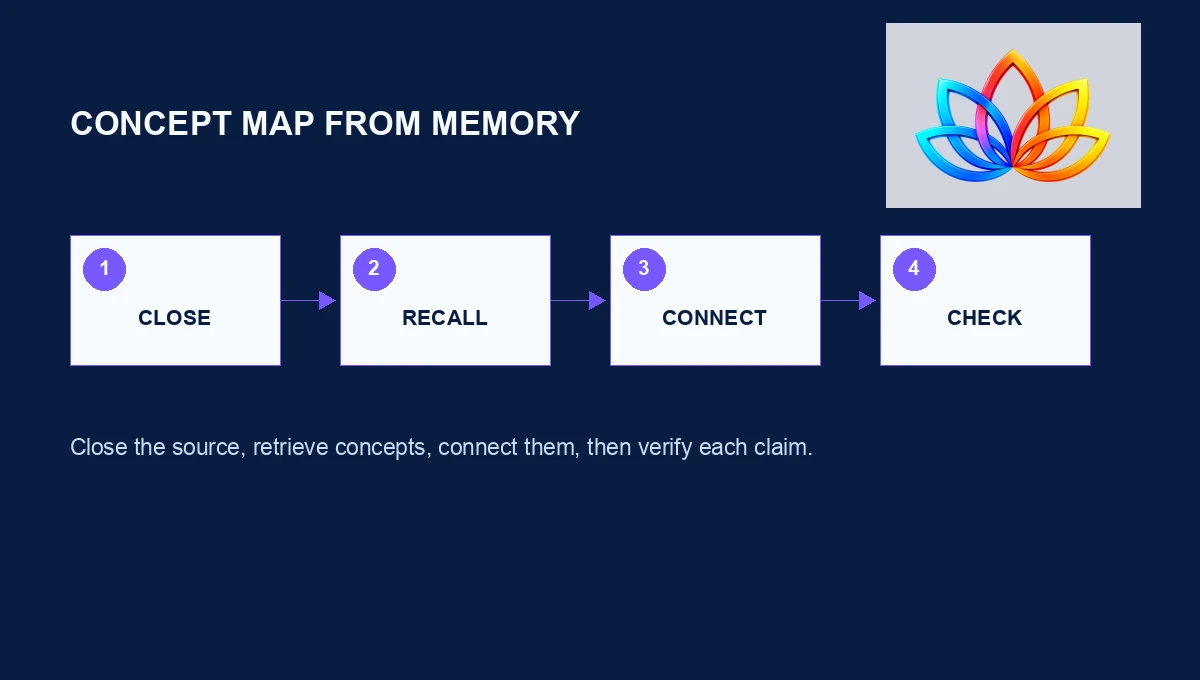
Close the source, retrieve key concepts, label their relationships and only then verify the map with visible corrections.

A concept map can be decorative copying or demanding retrieval practice. The difference is when the source is opened. Keeping the text visible makes it easy to reproduce its wording and order. Closing it forces you to retrieve concepts and relations before checking what is missing or incorrectly connected.
Blunt and Karpicke examined retrieval-based concept mapping in two experiments. One week later, paragraph and concept-map retrieval practice outperformed additional studying, while the two retrieval formats did not differ significantly. Nesbit and Adesope’s meta-analysis covered 55 studies and found heterogeneous results: benefits varied with how maps were used and the comparison condition. The practical claim is therefore limited. A map is not always the best tool; the useful routine is retrieval, connection and correction.
1. Define a small scope and close the source
Choose one coherent unit: a short chapter, lesson or related set of concepts. Before closing the source, write the question the map should answer, such as: “How does change A propagate to consequence D?” A question keeps the map from becoming an arbitrary list.
Put away the text, notes and previous diagrams. Write only the topic on a blank page or canvas. Looking back as soon as recall stalls turns the activity into recognition. A pause is useful evidence about weak retrieval.
Recall
Source: Closed
Main task: Concepts from memory
Evidence: First version
Connect
Source: Closed
Main task: Relations and direction
Evidence: Labelled links
Check
Source: Open
Main task: Compare with source
Evidence: Visible corrections
Retest
Source: Closed again
Main task: Independent reconstruction
Evidence: Second version
2. Retrieve key concepts before drawing links
List remembered concepts before arranging them. Use concise terms rather than copied sentences. When two terms are nearly synonymous, decide whether they are separate nodes or one concept with alternative wording.
When recall stops, ask: What causes change? What is measured? Which condition matters? What is an example and what is an exception? Mark uncertainty with a question mark instead of filling the gap with something merely familiar.
3. Label links with the relationship they express
An unlabelled line does not say whether one concept causes, contains, measures, constrains or illustrates another. Add a short relational phrase and direction where needed. Two nodes and their link label should form a testable statement.
Look for cross-links between branches, but do not add them for density. Say each relationship as a full sentence. If it is unclear or cannot be justified, the connection is not ready.
4. Open the source and correct in a different colour
Compare the map with the source only now. In another colour, add a missing concept, repair an inaccurate label or remove a false link. Preserve the first version: the difference between unaided recall and the checked map guides the next cycle.
Verification is not wholesale copying. Find evidence that supports or contradicts a particular relation. If the source is insufficient, mark an open question and consult another reliable source rather than guessing.
5. Explain the map without reading the source
Close the source and walk through the map aloud. Explain why each relation matters and give an example not copied verbatim. Then travel from consequence back to cause or from exception to rule. Reversing direction exposes links remembered only as a sequence.
Ask two inference questions: what changes if one condition disappears, and which new case has the same structure? If the map cannot support an answer, add the question to the next retrieval attempt.
6. Rebuild later and track change
After a delay, rebuild the map on a blank surface. Do not reproduce the visual layout; retrieve the important concepts, relations and boundaries. Compare the new version with the first map and the source.
Track concepts recalled without help, justified links and types of correction. Use these counts only within the same material, not to compare learners or unrelated subjects. A checklist, worked problem or performance test may be better for rigid procedures, formulas or physical skills.
- Define one question and a small scope.
- Close the source and retrieve concepts.
- Label relations, not merely lines.
- Open the source and preserve visible corrections.
- Explain the map and test inference.
- Rebuild it later on a blank surface.
7. Frequently asked questions
Must the map look polished?
No. Clear relation labels and defensible links matter more than symmetry.
May I look at the source?
Yes, during verification. The first version should show unaided retrieval.
How many concepts should it contain?
There is no universal number. Start with a unit you can explain and verify.
Are all links equally important?
No. Prioritise causal, conditional, hierarchical, example and boundary relations.
Does research show maps are always better?
No. Outcomes depend on task and use; retrieval was the critical element in the cited experiments.
What evidence should I keep?
Keep the first map, corrections, checked version and a note about delayed reconstruction.
8. Conclusion
Concept mapping becomes a learning exercise when knowledge is first reconstructed without the source, relations are explicitly named, and claims are checked only afterwards. Preserved corrections and a delayed rebuild reveal what is understood and what still depends on support.
Sources: Blunt and Karpicke (2014): retrieval-based concept mapping, Karpicke and Blunt (2011): retrieval and concept mapping, Nesbit and Adesope (2006): concept-map meta-analysis. Accessed 24 November 2026.
Continue with the guide to retrieval checks and confidence calibration.
About Meta Life Vision
Meta Life Vision is an educational brand within Yevt Group. YEVT DIGITAL works on the Meta Life Vision website and provides website development and other digital solutions.