
Learning Systems
Compare Two Solutions: Extract a Principle You Can Transfer
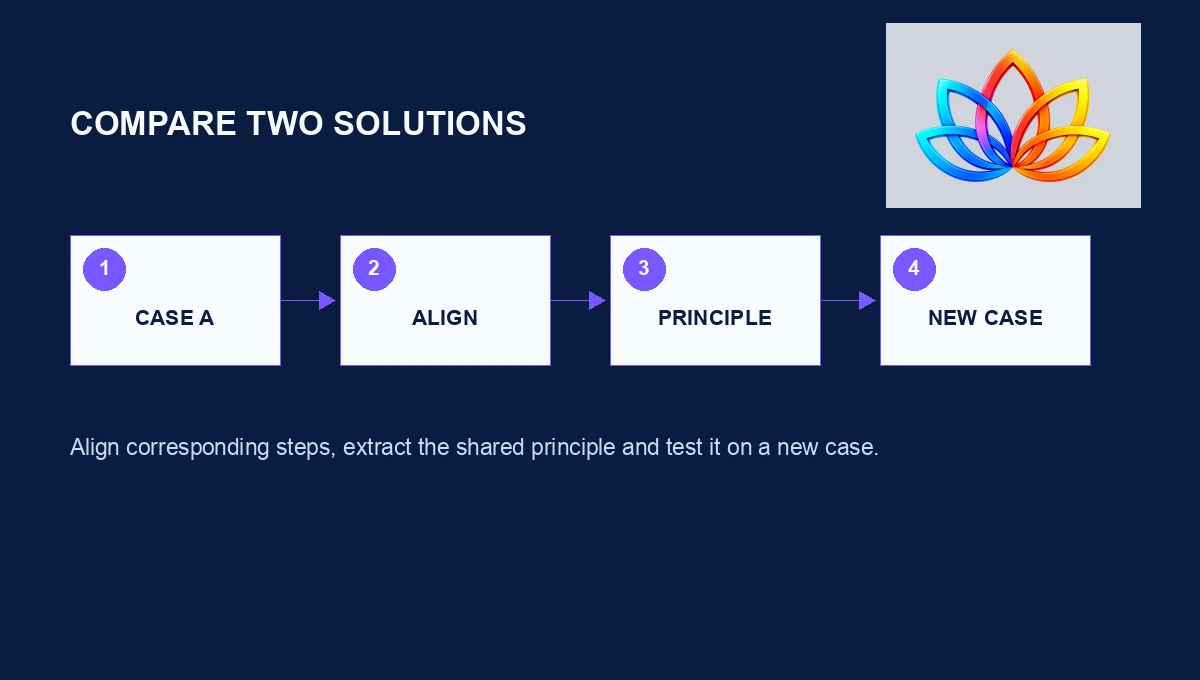
Align two cases, extract their shared relation and test the principle on a new example without relying on surface similarity.

Two examples can look completely different while relying on the same relationship. A learner may follow each example separately yet fail to see what they share, so the same principle is not recognised in a new situation. Deliberate comparison makes corresponding parts visible and gives the shared relationship an explicit name.
Research on analogical learning supports this approach in particular tasks, but it does not show that every comparison automatically produces transfer. In three negotiation-learning studies, Gentner, Loewenstein and Thompson reported better transfer when participants compared cases than when they studied them separately. Rittle-Johnson and Star experimentally examined how comparing solution methods affected conceptual and procedural knowledge about equations. The practical claim should remain bounded: choose comparable cases, align roles and steps, state the principle, and test it on a third case.
1. Choose two cases with the same deep structure
The cases should share an important relationship while differing in surface detail. Near-identical examples may invite recognition by appearance; unrelated examples invite guessing. In mathematics, use differently presented problems with the same relationship among quantities. In business, compare processes where early error detection reduces later cost.
Confirm that each case is understandable on its own. Record its goal, actors or variables, constraints, decision sequence and outcome before asking what corresponds to what.
Who has each role?
Case A: Actor or variable
Case B: Corresponding actor
Check: Same function
What triggers change?
Case A: Event or condition
Case B: Corresponding condition
Check: Relation preserved
What constrains the choice?
Case A: Rule or resource
Case B: Comparable constraint
Check: Not surface only
What is the outcome?
Case A: Consequence
Case B: Comparable consequence
Check: Principle explains both
2. Align corresponding parts step by step
Place the cases side by side and connect parts with the same function. Do not align items merely because they use the same word or object. A guard in one story may correspond to a software filter because both admit only items that meet a condition. The relational role matters more than appearance.
Ask: Who decides? What is the input? Which condition changes the path? What is preserved? Where does the consequence arise? Require evidence from both cases for each mapping. Comparison then becomes auditable rather than a free association.
3. Separate surface similarity from shared relations
Two situations may share a topic, colour or term while requiring different explanations. Conversely, they may look unrelated while expressing the same pattern: a limited resource, feedback loop, proportional change or conditional decision. Keep “what looks similar” separate from “which relationship is the same”.
Change the decoration as a test. Replace names, objects or domain while preserving roles and links. If the explanation still works, the relationship has probably been extracted. If it collapses when the topic changes, the learner probably retained surface features.
4. State the principle with conditions
Use one sentence: “When conditions X and Y hold, action Z leads to outcome P because…”. This identifies when the principle applies, the relevant action and the relationship that explains it. Slogans such as “always simplify” are too broad to guide a choice.
Add a boundary. Ask what would need to change for the principle to fail. A counterexample prevents overgeneralisation. If the principle cannot explain both original cases and exclude the counterexample, return to the mapping.
5. Test the principle on a new third case
The third case should preserve the relationship while changing surface details. Do not label the intended principle. The learner selects a principle, maps the roles and only then solves. Require a brief explanation linking the new case to the originals.
One immediate success is not proof of durable transfer. Check again later and include a case that looks similar but lacks the shared relationship. This tests both application and justified rejection when conditions are absent.
6. Record comparison as a repeatable process
Preserve the role mapping, shared relations, stated principle and result on the new case. When an answer fails, locate the break: one case may be misunderstood, the wrong parts matched, the rule overgeneralised or the new situation misclassified.
Change one source of difficulty in the next cycle. Increase contrast when roles are unclear, add a counterexample when the rule is too broad, or restore the side-by-side table when mapping fails. The goal is a principle the learner can explain and limit.
- Choose two understood cases with the same important relation.
- Align roles, conditions, steps and consequences.
- Separate surface details from shared structure.
- State the principle with conditions and an explanation.
- Add a counterexample or boundary.
- Test on a new case immediately and later.
7. Frequently asked questions
Should the cases be very similar?
No. They should share an important relationship, while surface differences help separate principle from appearance.
Is reading two examples enough?
No. The learner must actively align them, name the relation and test it on a new case.
How can I tell whether a principle is too broad?
State its conditions and find a counterexample where the same action would not produce the expected outcome.
What if the learner cannot find the connection?
Check each case separately, reduce the number of elements and ask about roles, conditions and consequences.
Does comparison guarantee transfer?
No. Research supports benefits in particular tasks, but results depend on case selection, alignment and testing.
What evidence should be retained?
Keep the mapping, stated principle, boundary and reasoned use on a new case.
8. Conclusion
Comparing two solutions becomes a learning tool when corresponding parts are aligned, surface detail is separated from relations, and the principle is stated with conditions and limits. A third case and delayed check show whether the learner transferred the principle.
Sources: Gentner, Loewenstein and Thompson (2003): case comparison and transfer, Rittle-Johnson and Star (2007): comparing equation solution methods, Loewenstein, Thompson and Gentner (2003): analogical learning in teams. Accessed 23 November 2026.
Continue with a guide to worked examples and gradual transition to independent practice.
About Meta Life Vision
Meta Life Vision is an educational brand within Yevt Group. YEVT DIGITAL works on the Meta Life Vision website and provides website development and other digital solutions.