
Learning
Check Your Recall: Explain a Lesson Without Looking at Notes
Try retrieval practice with one question, an answer from memory, a source check and a specific correction.

Choose one lesson, close your notes and try explaining the main idea in your own words. Then open the source and check your answer. That is the starting exercise in this guide: a small, inspectable attempt at recall, without grading or promising that one procedure will solve every learning problem.
Do you recognise the text, or can you explain it?
Retrieval practice involves trying to bring previously learned information back to mind. In Roediger and Karpicke's study using prose passages, prior testing produced better results on delayed checks than repeated study, while the immediate check showed a different pattern. This was the result of a particular experiment, not a guarantee of your individual outcome. Source: original research, 2006.
Reading with the notes open: “I understand this paragraph while looking at it.”
Checking with the notes closed: “I will try to explain the idea, then check what is missing.”
This guide proposes the second approach as a complement to reading. You are not asked to put the source away forever or guess when you do not know. The suggested output is a record: your answer, a comparison with the source and one specific correction. You can inspect that record yourself.
A practical framework: close, recall, check, repeat
The following procedure is an editorial suggestion for independent study. Adapt the duration, question count and schedule to the topic; they are not presented here as a scientifically established optimal dose. Start with a short piece of material that provides a trustworthy explanation.
- Choose a unit. Write down the lesson title and where you will check the answer.
- Ask a question. For example: “How would I explain this idea to a beginner?”
- Close the source. Answer without copying. Mark uncertain parts instead of filling them with confident language.
- Compare. Open the source and distinguish correct, incomplete and incorrect parts.
- Correct. Write a shorter, more precise explanation with a link to the relevant section.
- Return later. Try answering again without looking, recording the date of the new attempt.
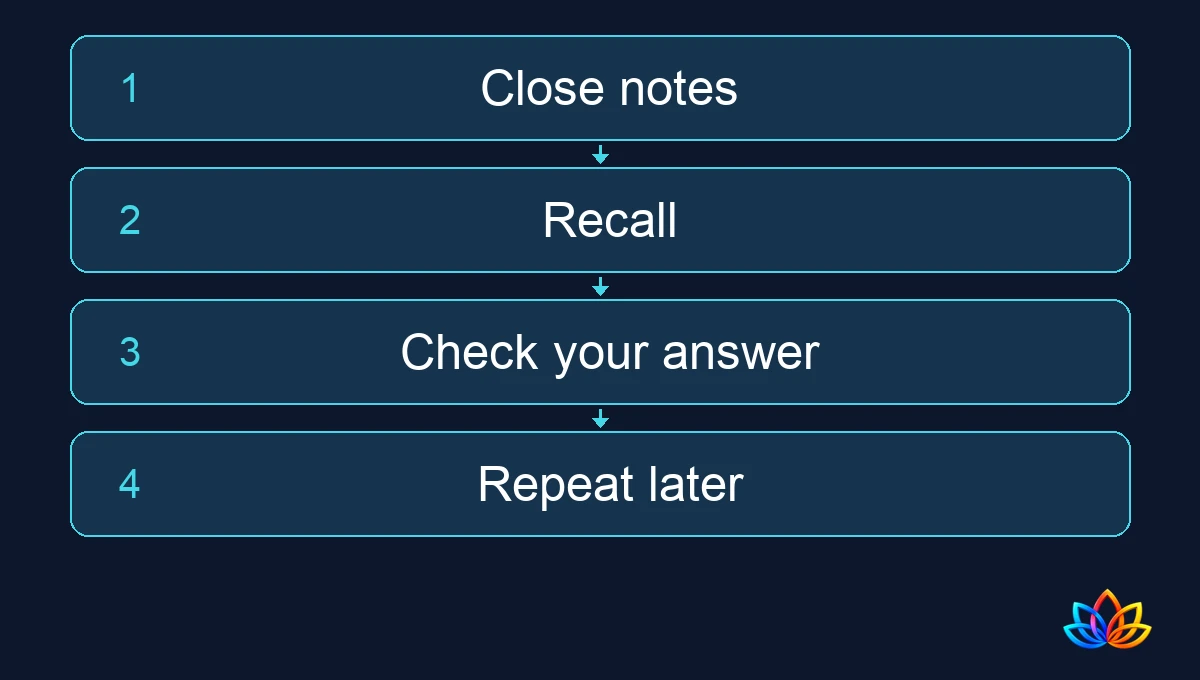
The authors of The Learning Scientists guide recommend checking answers after an attempt at retrieval and returning to the topic later. Our proposed exercise therefore does not leave the first answer without feedback. Source: the researchers' guide to retrieval practice.
Your specific task is to save one document with the fields “question”, “my answer without looking”, “source check”, “correction” and “next attempt”. Completing the task means producing that record, not achieving a promised percentage of retention in advance.
How can you shape questions for different material?
A concept you are getting to know
A suggested question is: “What does this concept mean, and which example distinguishes it from a similar concept?” Write the answer before opening the definition. When checking it, look beyond identical words: compare the meaning with the source and identify anything you added that the source does not support.
A procedure with several steps
For a practical skill, we suggest asking: “What is the sequence, and how do I check completion of each step?” After writing your answer, use the official instructions as the reference. Recall practice is not permission to carry out a risky procedure without instructions or work on real data.
The difference between two ideas
Write: “How do these approaches differ, and when would I need further explanation?” As an editorial addition, identify one limitation for each approach. This is a way to shape your exercise, without claiming the question pattern is best for every subject.
Do not turn every answer into a long essay. For this proposed trial, use a length that lets you check the meaning, relevant steps and possible mistakes clearly. If the chosen material does not provide a checkable answer, change the question or find a more reliable source.
An illustrative example: learning one procedure
Illustrative example, not the result of a real learner: someone is learning how to check a claim in an educational text. They have read a guide but want to see whether they can describe the process independently. They choose that same guide as their reference and record its address beside the task.
With the notes closed, they answer: “What should I check before repeating a number from an article?” They write their own sequence, then open the source and compare it. If they omitted the data's date or measurement context required by the guide, they mark the answer “incomplete”. They do not add a fabricated success percentage.
A suggested correction is brief: “This guide requires checking both the date and the scope of the data; those were missing from my answer.” At the next attempt, they ask the question again without displaying the completed correction. If they are still unsure, they preserve that uncertainty in the record.
The purpose here is to compare an answer with selected material. The example does not demonstrate lasting mastery or establish that the learner will check every source correctly. Assessing practical application would require a separate task that was actually carried out under suitable criteria.
Common mistakes in self-checking
- The answer remains visible. For this proposed exercise, hide it before the attempt and bring it back for the check.
- There is no trustworthy reference. Record where you will verify the answer rather than relying only on how it feels.
- The correction is vague. Replace “do better” with the exact part of the explanation that is missing.
- The exercise becomes a judgment of ability. We suggest describing the answer and the next step without attaching labels to yourself.
- One good attempt becomes permanent confirmation. Record its date and conditions; check future knowledge through a future task.
If the initial question is too broad, our suggestion is to reduce it to one idea. Replace “explain the entire course” with “explain the difference between these two concepts”. That is a practical adjustment to this exercise, not a claim about a universally best lesson size.
Your next step: make one checkable study card
Today, select a short lesson you already use. Write the question on the front of a card, keeping the answer and source separately. After trying to answer, save both the original attempt and the correction. You can then distinguish what you recalled independently from what you added after checking.
To connect checked understanding with concrete work, read the existing MLV article How to Turn Knowledge into Practice. The narrower task here is checking recall; application in actual work remains a separate next step.
Frequently asked questions about retrieval
Does self-checking replace the first reading?
Not in the proposed exercise. First select and study the material, then attempt an answer and check it.
Should I look at my notes while answering?
Hide the answer for the recall attempt, then use your notes to check it. The cited researchers' guide recommends this sequence.
What if I cannot remember anything?
We suggest recording the difficulty, rereading the relevant part and narrowing the question. Do not invent an answer just to fill the field.
Does this method guarantee a better grade?
We make no such guarantee. The cited research describes results under its experimental conditions, not every reader's outcome.
When should I try again?
Record a next attempt that fits your plan and material. This guide does not claim the same interval is optimal for every person and topic.
How do I know the exercise is complete?
Under the proposed criterion, you have saved the question, original answer, source comparison and specific correction. That is different from evidence of lasting mastery.
Conclusion: keep the answer before correcting it
Start with one question. Try answering without looking, compare the attempt with the source and write one correction. This small record provides a basis for the next check and clearly distinguishes an attempt from a solution read afterwards. Base further conclusions about your learning on actual later attempts.
Sources, accessed November 6, 2026: Roediger and Karpicke — Test-enhanced learning, 2006; The Learning Scientists — Retrieval Practice. The card, questions and illustrative example are editorial suggestions for study.
About Meta Life Vision
Meta Life Vision is an educational brand within Yevt Group. YEVT DIGITAL works on the Meta Life Vision website and provides website development and other digital solutions.