
Digital Literacy
How to Check an Online Source with Lateral Reading
Leave an unfamiliar page, investigate who is behind it, compare independent coverage and trace the claim to its origin.

When an unfamiliar page makes a persuasive claim, it is easy to stay on that page and look for signs of credibility: polished design, a long author biography or many links. Lateral reading changes the order. After a quick scan, you leave the page, open other sources and investigate who is behind it, what reliable sources say and where the claim originated.
Why can reading one page deeply mislead you?
Wineburg and McGrew observed 45 participants — 10 PhD historians, 10 professional fact-checkers and 25 Stanford undergraduates — as they evaluated live websites. Historians and students were more likely to remain within a site and rely on features the site's owner could shape. Fact-checkers left after a short scan and opened other tabs to evaluate the source.
This is a finding from a specific sample and set of tasks, not proof that one technique determines truth without error in every situation. Its practical value is the change in the opening question: before analysing the text's details, investigate who is speaking and how independent sources describe them.
Vertical approach: stay on the page and judge it mostly through what it says about itself.
Lateral approach: note the claim briefly, leave the page and check the organization, coverage and origin in other tabs.
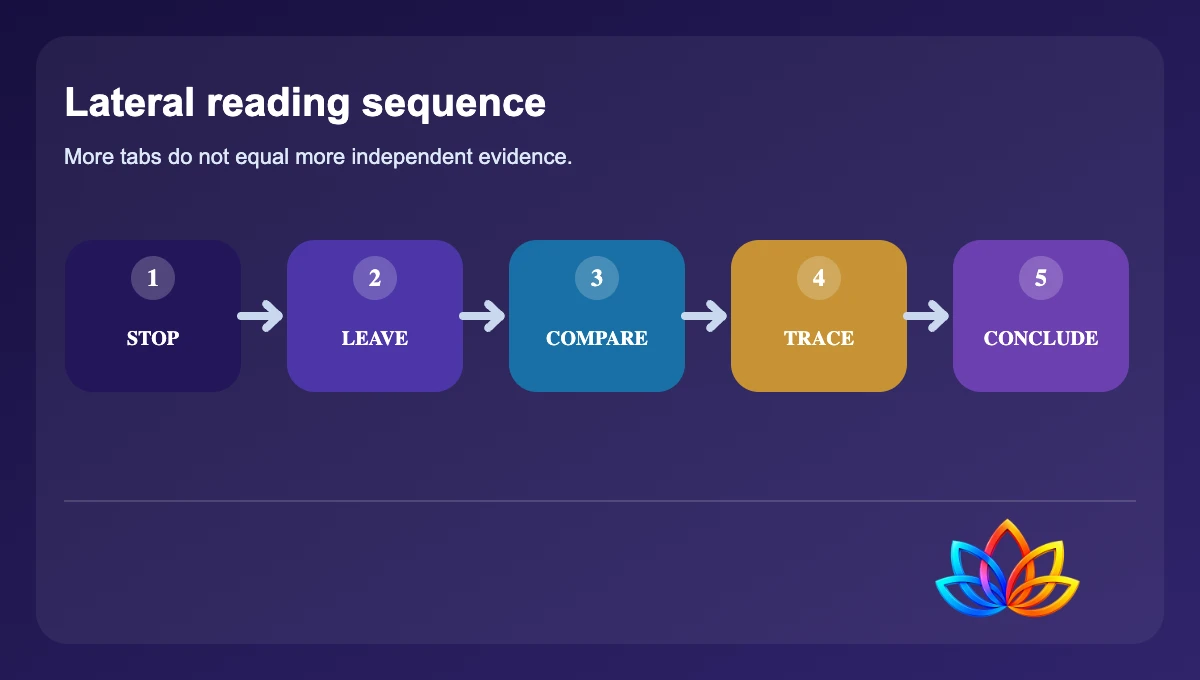
A practical framework: stop, leave, compare, trace, conclude
- Stop. Write down the exact claim and do not share it before you know what you are checking.
- Leave. Open a new tab and search for the source, organization or author.
- Compare. See how relevant sources outside the same site or network describe them.
- Trace. Follow a quotation, number, image or study back to its original context when possible.
- Conclude. Separate what is supported, disputed and still unverified.
Task: choose one public claim, copy it without changing its meaning and open no more than four carefully selected tabs: source background, independent coverage, original evidence and a relevant expert correction if one exists. Write one sentence on what each tab actually adds.
How do you choose useful tabs for checking?
Who is behind the source?
Search the organization's full name with terms that reveal ownership, funding, editorial practice or relevant expertise. Do not rely only on its About page; compare it with independent registries, public documents or reputable reporting appropriate to the topic.
Is the coverage genuinely independent?
Ten pages copying one report are not ten independent confirmations. Trace links and repeated wording backwards. If they all lead to one press release, record one source and that limitation rather than presenting the result count as consensus.
Where is the original context?
For a numerical claim, look for the original dataset or research; for a quotation, the complete speech, document or interview; for an image, the earliest publication and date. An original is not automatically correct, but it lets you examine what was actually said, measured or shown.
Which expertise is relevant?
Authority depends on the question. Expertise in one field does not automatically support a claim in another. Record what qualification or access to evidence the source has for the particular issue you are checking.
An illustrative walkthrough: a claim about a learning method
Illustrative example, not a real recommendation or verified result: an unfamiliar blog claims that a method “doubles learning”. The exact wording is recorded first. Because the claim describes a measurable result, it needs an outcome definition, sample, comparison and original evidence — not merely repeated phrasing.
A new tab investigates who runs the blog. A second seeks independent coverage of the method. A third traces the cited study to its publisher or journal. If the blog links to another article that links to a press release without data, the trail stops with the note “original evidence not found”.
The final record does not have to be simply “true” or “false”. It may say: “I found the claim's origin, but the source does not measure the stated outcome,” or “I cannot confirm the number because no methodology is available.” That conclusion is more useful than confidence without evidence.
Common lateral-reading mistakes
- Searching the entire sentence without evaluating sources. Results may only repeat the same text.
- Counting links as confirmation. Check whether the sources are independent.
- Accepting the first search result. Search position is not evidence of reliability by itself.
- Seeking only material that supports the first impression. Include a relevant source that could challenge the claim.
- Conflating the organization with the claim. A reliable organization can err, while an unreliable site can repeat a correct fact; assess both levels.
- Concluding without boundaries. State what was not checked and why.
Your next step: write a five-sentence record
The exercise should take as long as the claim requires, not a promised universal number of minutes. Write: (1) what the source claims, (2) who is behind it, (3) what the best independent source says, (4) where the original evidence is and (5) what you can or cannot conclude. If a key link is missing, write “I cannot confirm this” instead of filling the gap with an assumption.
For further learning, choose a currently available article on the Meta Life Vision blog that matches the skill you want to develop. This article does not confirm a particular course, price or learning outcome.
Frequently asked questions
Does lateral reading mean I should not read the original page?
No. It means checking outside context early, then returning to the original with a better understanding of the source and claim.
How many sources are enough?
There is no universal number. Independence, relevance and proximity to original evidence matter more than the number of tabs.
Does professional design prove reliability?
No. Design can improve usability, but the publisher controls it and it is not independent evidence of accuracy or expertise.
Is the original source always correct?
No. It reveals context and methodology, but it can still contain errors, bias or limitations.
What if outside sources disagree?
Compare their evidence, dates, methods and relevant expertise. If the disagreement cannot be resolved, record it clearly.
Can this method guarantee that a claim is true?
No. It improves the evaluation process but does not remove uncertainty or replace specialist analysis when the stakes are high.
Conclusion: check context before details
Lateral reading is not a shortcut to judgment but a disciplined order: preserve the claim, leave the page, investigate the source, trace the evidence and limit the conclusion to what you actually found. The next time a page persuades through appearance or confident language, open a new tab before accepting its account of itself.
Sources, accessed November 9, 2026: Wineburg and McGrew — Lateral Reading and the Nature of Expertise (working-paper version); Breakstone et al. — Lateral Reading in an Online Course. Numbers and findings refer to the specific studies; the exercise and illustrative example are editorial suggestions.
About Meta Life Vision
Meta Life Vision is an educational brand within Yevt Group. YEVT DIGITAL works on the Meta Life Vision website and provides website development and other digital solutions.