
Ai Literacy
Check an AI Answer Before You Use It: Claims, Sources and Limits
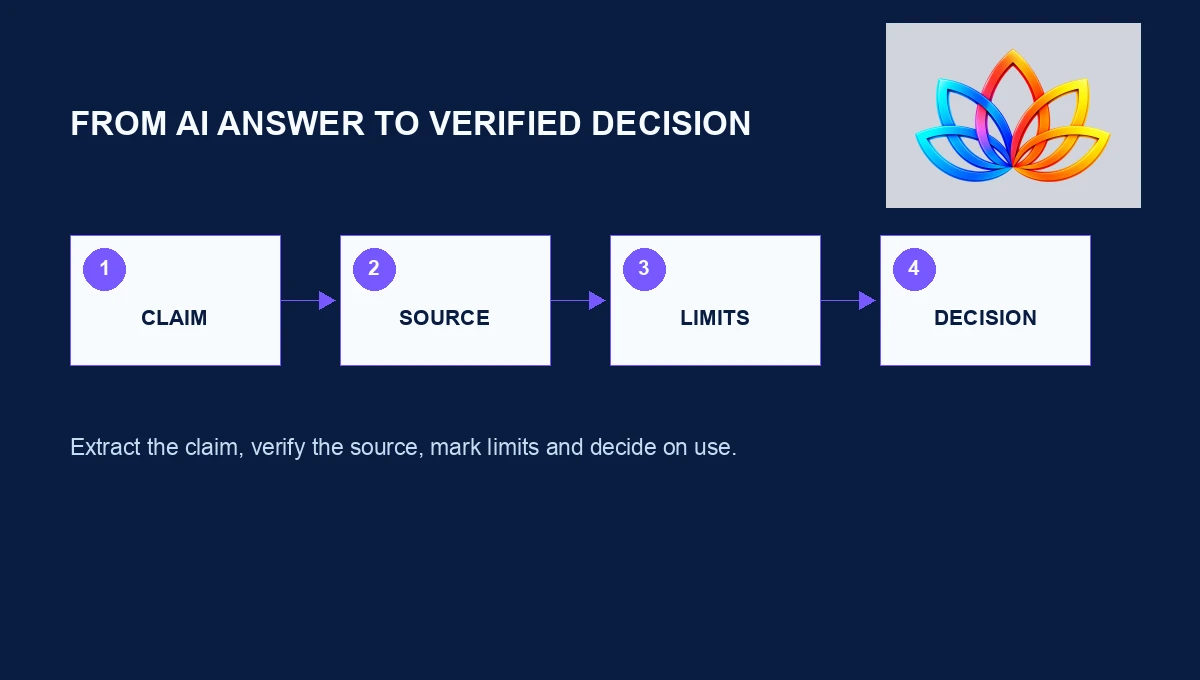
Extract verifiable claims, estimate the consequence of error, open primary sources and record what you can confirm.

An AI answer can be clear, useful and well written while still containing a false fact, fabricated reference or hidden assumption. Fluent prose is not evidence of accuracy. OpenAI therefore advises users to verify important information with reliable sources, while NIST’s generative AI risk profile specifically recommends reviewing and verifying sources and citations in system outputs.
The goal is not to turn every draft into a research project. Identify what needs evidence, estimate the consequence of an error and spend the most effort where a wrong detail would change a decision. The result is not merely “true” or “false”, but an explicit choice: use, correct, limit or discard.
1. Separate facts, suggestions and text transformation
First identify the kind of result you requested. Translation, rewriting your own text and summarising supplied material carry different risks from an answer that introduces dates, rules, statistics, technical parameters or quotations. A transformation can still be wrong, but its first check is a comparison with the supplied source rather than a general web search.
Underline verifiable claims: names, numbers, causal relationships, statements about what a document says and recommendations that depend on an external condition. Keep them separate from editorial suggestions and illustrative examples. A suggestion may be useful without external evidence, but it must remain a suggestion rather than a confirmed fact.
| Part of the answer | First check |
|---|---|
| Claim about the world | Find a reliable primary source. |
| Summary of a supplied document | Compare it with the exact passage. |
| Calculation | Repeat it and check units. |
| Suggestion or idea | Check conditions, risk and fit with the goal. |
2. Decide what an error would cost
Not every statement needs the same level of scrutiny. A wrong colour in a sketch idea does not carry the consequences of an incorrect deadline, medical claim, legal condition, financial amount or technical instruction that changes a production system. The higher the consequence and the harder the recovery, the stronger the source and review must be.
Use three levels: low, medium and high consequence. A low-consequence item may need a quick comparison with the original. A medium item needs a primary source and an independent check. For high-consequence decisions, do not use AI output as a substitute for a qualified professional; use it only to draft questions or organise checks.
3. Move from claim to source, not from citation to trust
When an answer cites a source, open the actual page or document. Confirm that the title, author, date and publication exist, then locate the passage that supports the claim. A working link does not prove that the linked page supports the sentence. NIST explicitly recommends reviewing and verifying sources and citations in generative AI outputs.
Prefer the primary source: official documentation for a technical feature, the original study for a research result, current legislation for a rule or an organisation’s own document for its policy. A secondary source can explain context, but it should not replace the document to which the claim directly refers.
4. Check numbers, dates and conditions
A number without a unit, period and population often looks more precise than it is. Repeat the calculation, check the inputs and record where each one came from. For a percentage ask: percentage of what, relative to which baseline and over what period? For technical information, confirm the product or standard version.
The access date matters for changing information. A price, schedule, feature availability, platform rule or responsible person may change after the answer was produced. If the information cannot be confirmed as current, remove the detail or state the limitation instead of presenting an old value as current.
5. Look for what the answer left out
Inaccuracy is not the only problem. An answer may be partly correct while omitting a condition, exception or contrary evidence. Ask: when does this claim not apply, what data is missing, whose perspective is absent and does the conclusion exceed the source? These questions do not prove the answer wrong; they identify where another check is needed.
Do not ask the same model only to confirm its own answer. It can help extract assumptions or propose verification questions, but final confirmation must come from a source, repeatable test or expert review. A confident tone is not a reliability measure; OpenAI warns that a model may sound confident while being wrong.
6. Run a ten-minute review before use
For an ordinary business or learning draft, use a short final routine. Save the prompt and answer, extract the most important claims, verify their sources and record what you could not confirm. Then create a clean version in which unverified claims are removed, rewritten as assumptions or marked for review.
This is an illustrative workflow, not a universal guarantee. Ten minutes may be enough for low-consequence text, but it is not enough for a high-risk decision. Scale review time to consequence, how quickly the information changes and whether a primary source is available.
- Mark three to five claims that carry the conclusion.
- Open a primary source or original document for each one.
- Repeat calculations and check units when numbers are used.
- Record the date, version and important condition.
- Mark each item confirmed, corrected, limited or discarded.
- Keep the verified version separate from the first AI draft.
7. Frequently asked questions
Must every sentence be checked?
Not with the same intensity. Prioritise claims that drive the conclusion, changing information and items whose error would have serious consequences.
Are links supplied by AI enough?
No. Open the link, confirm the source exists and check whether the specific passage supports the claim.
How should I check a document summary?
Compare key claims with the relevant sections of the original and confirm that conditions, exceptions and scope were preserved.
What if I cannot find confirmation?
Write “I cannot confirm this”, remove the claim or turn it into a clear question for expert review.
Can another AI model provide independent confirmation?
It may reveal different questions, but agreement between models is not evidence. Confirmation comes from sources, tests or qualified review.
When is an expert needed?
When the output affects health, law, finance, safety, employment or another high-consequence decision.
8. Conclusion
Treat an AI answer as a working draft, not automatic evidence. Separate facts from suggestions, estimate the cost of an error, open primary sources, check numbers and record conditions. When evidence is missing, say “I cannot confirm this” instead of filling the gap with confident guesswork. Practical AI literacy is neither blind trust nor automatic rejection; it is a traceable verification decision.
Sources: OpenAI: Does ChatGPT tell the truth?, NIST AI 600-1: Generative AI Profile, OpenAI Terms of Use: accuracy and human review. Accessed 16 November 2026.
Continue with the practical guide to checking online sources through lateral reading.
About Meta Life Vision
Meta Life Vision is an educational brand within Yevt Group. YEVT DIGITAL works on the Meta Life Vision website and provides website development and other digital solutions.